Showing posts with label classroom decor. Show all posts

Sunday, July 31, 2022

Crossposted: Valuing Ourselves and Our Time, Influencers Should also Share the Basics

 There's a barrage of summer classroom setup posts, photos, and videos to sift and scroll through when I check in on my social media, which is very much aligned with my own work calendar as I officially return to my library this upcoming week.  I'm discovering new-to-me posts with educators and friends of education reminding colleagues and others that none of us should be giving our employers our work "for free" by returning to classrooms and libraries and labs and school buildings any earlier than our official report date.

Which I totally get.

At the beginning of my teaching career, I couldn't ever enter my classroom over the summers (unless I was teaching summer school within the same building). I was afforded some access during the weekends, and I could stay into the evenings during the weekdays if the night custodian was in the building.  After Uncle Sam started moving our family from post to post, I was allowed "new-teacher-time" so I could see my teaching space, put my hands on curriculum materials, and deliver my own gear to be sorted and stored. Since arriving in this district, I've had access to my classroom space each summer after our incredible custodial crew has shampooed carpets and rugs, dusted nooks and crannies, and cleaned windows inside and out. I shared many a post at Kindergarten's 3 Rs describing not only classroom organization, space arrangement and decor decisions that I made during these before-contract hours, but also quick-peek photos explaining other tasks that a veteran teacher simply didn't have time to work through during the actual school year, such as sorting through posters and bulletin board displays accrued over eighteen years of teaching.
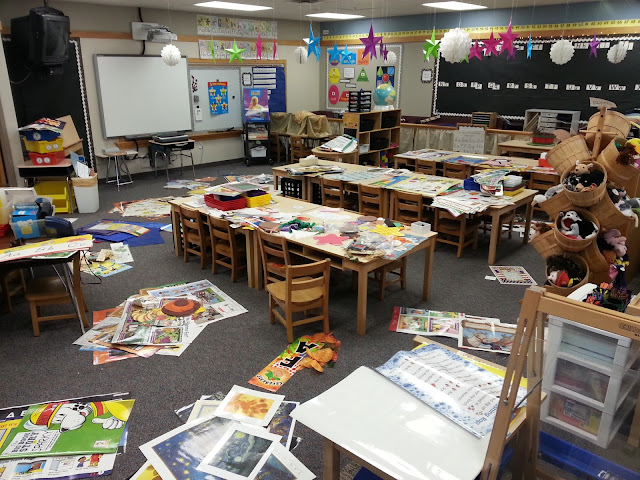

Could I have taken care of this job during the one and a half work days scheduled?  Possibly, after scrambling through furniture arrangement, opening curriculum boxes, student materials prep, bulletin board displays, lesson planning, teacher mentoring, collegial hey-how-was-your-summer chit-chat, lunch, etc. but... likely not. 

"Your classroom doesn't have to be a Pinterest/TikTok/Whatever showcase, you can just do the minimum" is also advice currently being shared by well-meaning folks.  Creating an inviting space that didn't terrify kindergarteners was my goal before social media existed. That's right, stuffed animals, my own picture books placed within easy reach, puppets, building blocks, paint, brushes and smocks, Play Doh, computers, beanbags, word walls containing students' names, pencils, crayons, markers, construction paper and glue, and letter and alphabet posters and toys ("manipulatives") were always part of my classroom set up and after get-to-know-your-teacher-day greatly influenced whether or not a child sobbed and screamed for their parents on the first day of school or bravely entered the classroom solo, quickly making new friends.  Photos providing a classroom tour were also added to our web page so incoming students and families could have a sneak peek before arriving. Hallway displays welcoming students to our classroom made it easy for five-year-olds to find our shared space as they became familiar with the building. The week after school started, they and multiple surfaces within our classroom were covered with student work, crafts, and creative constructions.  Our space screamed to be shared, not only with those in our building daily but with our families who couldn't visit often, so I took photos and emailed them. To help other teachers and to document my own work for myself and my professional reflection, I shared pictures and ideas via the blog. I never became famous or trended, but college students and other new-to-service teachers reached out on occasion, asking to share my content as a resource.  After a while, colleagues would tell me that they saw my craft idea or table arrangement on Pinterest.  It was cool. But it wasn't my focus.

The bare minimum for many teachers has meant classrooms with damaged vinyl floors, empty bookshelves, peeling paint, no air conditioner, and few if any materials for student use. Despite districts' responsibility to provide for their students, it can often appear (for whatever reason) that their practice is to supply as little as possible and/or to allow retiring teachers to leave behind file cabinets bursting with outdated worksheets and cabinets full of "someday I'll need this" items, hoarded (yet unused) for decades.  A single work day isn't going to cut it in these cases, and if you're a teacher with kids, coming in on the weekend during the school year isn't always feasible either.  As inappropriate as it may be and may feel, sometimes we do take what we can get, so many of us spend unpaid time over summer break which we use for the most part to acquaint ourselves with our learning space in order to make it efficient, effective, and welcoming for students. Some classroom spaces need more work than others, and some look like they need an exorcism. I appreciate colleagues that rise to the challenge, and I sympathize with teachers who find themselves drowning in overwhelming seas of isolation. 

I've spent three half-days in the library this summer, which is the least amount of time I've ever been in the building outside of the school year since joining my district sixteen (seventeen?  Goodness, I've lost count.) years ago. Last summer I spent fourteen ten-hour days straight in the space because of the complete overhaul it needed.  I'm certain that investment of energy and thought directly correlates to the small amount of time I've needed so far this year, though it was made necessary in the first place because the librarians before me didn't have the time to sort through all that they had inherited and should have purged before leaving. Would I have liked to have been paid for one hundred and forty hours of my time and effort or been recognized in some other way by administrators?  Absolutely.  Should I have been paid for the work?  I believe so, but the applause during our first staff meeting had to be enough before I'd reap the eventual rewards that were to come throughout the year.  While those rewards did not put food on my table, gas in my truck, or reimburse me for the thousands of dollars of my own money that I spent to get the space in order, the peace of mind I experienced in knowing that my students and I were as sure-footed as we could possibly be was worth it.  During this time of COVID, in my starting this new job, having a sense of control served as a significant part of my self-care, but not every educator can find a silver lining or balance without actual income. 

Before you think I'm representative of solely one side of a range of edu-issues, there is a facet of the current criticism of unpaid summer work that does resonate with me, and it has for at least a decade now: zhushing classrooms rather than setting them up for mutual use by teachers and students. Seeing so many classroom "transformations" that include wallpaper, paint, faux-foliage walls and boards filled with funky-font anchor charts and signage, and every surface covered with contact paper with no apparent areas left for student input, work, artwork, and creative contributions appalls me. Seriously: pre-printed everything has become the new sage on the stage.  When you leave no room (or only a single 3 X 5 board that you change quarterly) for student work/contributions, you imply that you do not value their work, and you make it near impossible for them to reflect upon it, take pride in it, learn from others, and solicit and provide feedback to one another.  As for the affirmation posters and anchor charts featuring cursive or other funky fonts that younger students C-A-N-N-O-T  R-E-A-D and certainly cannot write being plastered all over doors and walls and bulletin boards and easels in primary classrooms?


Teachers downloading and reprinting or recreating from scratch every single printed element in their classrooms each August because they "must" have a different theme?  No... no.  That's not working smarter. And as for those companies who promote cute over substance (you know who they are, they're the ones that have you convinced to go out and buy ten vintage-looking candy jars so that you can run them across the top of a bookshelf and fill them individually with single colors of crayons so your students can "go and get the color that they need" when they've lost, or eaten, or broken, or whittled theirs...) they're not helping you (or your students, who need many opportunities to sort, classify, search, track, compare, evaluate, develop fine motor skills, and select) work smarter, either. A classroom's purpose isn't for social media accounts or to provide affirmations that your employer and/or colleagues might not be offering you.  Your primary job as a teacher isn't to trend, it's to teach. Your space doesn't belong to only you, and your favorites don't appeal to everyone. Engage your students and provide them with a template or canvas, but put every tchotchke that speaks to YOU behind and on your desk, above your bookcase or file cabinet, and on the pinboard in your space where you can see it. Allowing students to have and contribute to their spaces, with their writing, coloring, and creativity frees up your time from decorating (and spending a lot of your money on) every available inch within your room.  Define your "influence" by your contributions to education and your support of students and colleagues. Maybe you'll choose to share via social media, or only via in-building or in-district mentorship, too.

Whatever algorithm I toggled after searching for and viewing classroom and library decor on social media, it's been difficult to adjust in order to find more middle of the road, veteran educators such as myself. The "influencers" that my searches have shown to me aren't sharing some truly helpful, non-stylized teacher tips when considering your students' learning environment, such as:

  • If you're able to plan for another year or three to five in advance, create organizational and instructional goals that you can work on over time.
  • Ask a veteran teacher about the meat and potatoes, the substance of teaching and learning, and don't be surprised when they don't mention desert, jungle, rainbow, or beach color schemes.  
  • Your goals should be longer than your list of decor trending items that you're replacing every year.  
  • Take a week this summer to envision and build the foundation of the environment you will share throughout the year with other contributors (the students). You're going to need the time to arrange and rearrange. 
  • Sort, purge if necessary, and determine actual essentials, identifying the difference between needful things and wantful things. 
  • Give yourself an hour (or three) to make your own space comfortable and appealing to you. Your own space is your desk area, a bookcase, file cabinet, cabinetry, or shelving behind your reading table or in my case, the book repair room behind the circulation desk.
  • If your job or placement might change after a year, invest in a neutral or simple theme, no unicorns, cacti, ninja, or rainbow characters overload.  
  • Next summer, take a day or a day and a half to do these same jobs, without having to recreate the wheel. Acquire over time, and keep and replace when necessary tried-and-trues.
Like most things in education, one size really doesn't fit all when it comes to how we value our time and one another. Should teachers ever have to work for free?  No, yet we've had to for generations.  Is it appropriate to advocate for ourselves?  Yes, because the majority of us understand that being at our best benefits students. Finding what works for you without it depleting your life savings or negating any contribution by students is a reasonable back-to-school goal, which from my quick peeks at social media isn't necessarily what influencers seem to be advocating, nor a truth that all teachers naturally intuit.  

*****

Saturday, August 22, 2020

My New Classroom in the Time of COVID-19

I'm a remote learning kindergarten teacher this year.  In my district, this means that I will still report to my school building each day, but will teach students from my classroom via Loom, Google Classroom, and pre-recorded content videos while other teachers' students join them for face to face instruction on campus.  My new classroom is a teaching space that would never in a million years be able to support all of the materials, furniture, decor and experiences that my previous room did, but I selected some essentials that remained with me in the building while everything else was brought home. I hope to be able to mount my laptop (camera) on a swivel stand in the middle of the circle, so as I move from location to location, all I have to do is check for focus and framing, without trying to finagle the right height for my laptop in each location, risking gravity's inevitable assertion.

Here's the "before:"

I've arranged my classroom into three areas.  The first is my instructional "circle," which includes in a clockwise rotation my SMART Board, a reading table, bins full of ELA and math manipulatives that can be displayed via projection provided by a document camera, an art easel for painting and craft table for demonstrations/tutorials, and a big book, calendar and story time area next to a cart that is positioned next to the SMART Board. The second is my office area, complete with desk, second monitor that can be hooked up to my laptop, my bulletin board and curriculum storage, and a large table that I can use to sort consumables, create work packets (hopefully), and spread out curriculum guides or other bulky items if needed.  The last area is the real estate for my bulletin board displays and other visuals such as anchor charts and dry erase surfaces.  

Here's the view from my desk (my SMARTBoard is against the far wall, past the big book stand and storytime easel):

I've been keeping half of the room's lights off and the projector of the SMARTBoard dimmed this past week in an attempt to keep the room as cool as possible.  Even with the help of two oscillating fans, I haven't been able to get it cooler than seventy-three degrees, which, no joke, is almost ten degrees hotter that I like any room to be. There are no quilts or lots of puppets and stuffed animals in my room now because we need to minimize the amount of fabric and other porous surfaces into which I and other visitors to my room may come into contact, but the bulletin boards are prepared and surfaces are decorated as they would be if my students were going to be with me in-person. I plan to photograph our sound wall, a display of our 7 Habits, our sixty Power Words, our math vocabulary wall (it's taped to cabinetry), and the front of our room in case a Bitmoji-style room isn't allowed for reference on a Google Site or in Google Classroom.  Even if our building is closed again like it was last spring, I should be able to use the pictures I've taken as reference materials online. 

To the right of my desk, behind the instructional circle is a long table, rolling cart, and bulletin board/tub storage.  I anticipate this area will end up full of math workbooks, packets, and whatever other resources I might be providing to my students.  Because there's a huge bulletin board in this area, I've put up a sound wall that I can easily photograph for my students' reference.  All of my ELA book tubs are stored within easy reach, though I don't know yet if my students will be able to borrow and use books at home, or if they'll only have access to them digitally.


Though I'm hoping I'll be able to teach effectively for the school year from within this classroom, I'm setting up an instructional closet area at home in my craft room should our buildings be closed again like they were in the spring. Over-prepared is better than under-prepared, right?

This year my classroom won't be full of students or their work, creative constructions, or seasonal crafts.  It will be odd, and even uncomfortable. I'll be hearing other children and colleagues as they pass by my classroom each day and it will be an adjustment to only interact with my own students via a screen with little if any time in each other's presence.  It will be refreshing yet unusual to eat my lunch and snacks and drink my water outside for as many days as it is possible.  It will be uncomfortable, worrying about what might be in the air all around me indoors, and what I might bring home with me each day.

No, I cannot take a year without pay.  I'm at least fifteen years away from retirement.

Vigilance. Grace.  Hope.  Patience. "Preparedness." 

I'm not sure they, or my organizational efforts, will be enough.

Monday, December 19, 2016

Kindergarten in December

Friday was our last day of kindergarten until 2017, and like many of you, December was such a busy month for me and my Super Stars that I'm only now able to share some photos.  I spent Saturday vegging out (my brain was able to do little else, really), and yesterday *finally* putting up our Christmas decor at home.

Needing to clean up my laptop, I came across photos of some of the December fun we enjoyed in kindergarten- take a peek!


End of the quarter assessments were completed little by little each day, but we very much wanted to decorate for Christmas!  Tearing red, white, and green paper to create candy canes was a fun fine motor activity during center time.


We reviewed plane shapes while creating classroom decor...


... and AB patterns with paper chains as we counted down the days to Christmas.


What would December be without one of our favorite story characters, or frankly, MANY Grinches, arranged into a Grinchmas tree?


Rudolph, with your nose so bright, won't you guide my sleigh tonight?  These crafts helped us to attend to, remember, and create as we followed directions in sequence.  We also strengthened our finger muscles by ripping paper for Santa's beard.


Graham cracker "gingerbread" house construction was a tasty STEM activity...


... and we made some snowy friends that will greet us when we return to school in January!


*****

Merry Christmas, Happy Hannukah, Happy Kwanzaa, and Best Wishes for a Joyous New Year!

~Michaele~

Tuesday, June 23, 2015

Need a New Source of Classroom Inspiration? E-t-s-y !

It's summer, and if you're like many teachers, you're ready to track down new and inspiring resources and design elements to help create the perfect learning environment for your students... or you're still catching up on naps.

Whether you're taking part in book studies, sales shopping, or attending conferences, the thought of tackling furniture arrangements and bulletin board displays will eventually cross your mind.  If you're anything like me though, you'll notice that trimmers, anchor charts, and manipulatives featured in teacher stores and catalogs have all started to look alike, no matter the animal, super hero, or polka dot pattern used.

They're tried and true stand-bys, and I'll appreciatively admit that Bordette corrugated trimmer has ~saved~ my bulletin board displays on more than one occasion, but if you're wondering what else might be out there (and you're the creative sort who isn't afraid of scissors, a glue gun, Mod Podge or printing in color), I've got the perfect place for you to find fresh inspiration:


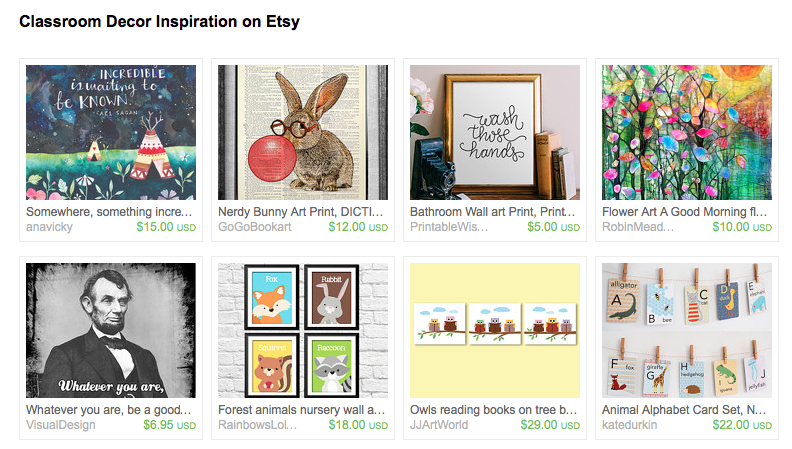
Oh yes, take a gander at art prints, bunting, printable posters and manipulatives available on Etsy, and let your imagination, creativity, and craftiness be inspired.  I've created a treasury of items that caught my idea for classroom consideration here


How about these?  Teaching in Kansas, The Wizard of Oz is one of my favorites.  Illustrations, typography, and textural elements can all contribute to the feel and comfort of our students' learning spaces.


You can join Etsy for free, and search to your heart's content.  I use terms like "art print," "bunting," "classroom decor," "teacher gifts," "quotations," and "nursery" when I'm on the hunt for ideas.

Where else do you find inspiration for your classroom?  The great outdoors?  Museums? Travel?  Movies or television shows?

Wednesday, July 09, 2014

Teacher Tip: Media Cart Modification

Occasionally, teachers no longer want or need a particular piece of furniture or equipment.  I inherited a gray metal book cart in May, first-come-first-serve style.

That's right, I jogged walked safely (yet quickly) up the hallway to retrieve it when the teacher sent out the come-and-get-it email.

Mobile vertical storage comes in handy for kindergarten students.  Materials can be rolled to different parts of the classroom or hallway, and the backside of the cart, with a teeny tiny modification, can become an additional display surface.


This year, I want to hang chart/writing paper tablets on the back of the cart.  Heavy duty magnet clips worked for one chart, but they weren't strong enough to hold two.  Hello Command Hooks!  I chose the style with the metal hook and bead since I figured they'd fit through the holes that are punched through every page of the tablets.


I positioned the chart tablet where I wanted it to hang, and slid a hook into the backside (without removing the clear strip from the adhesive) so I could determine where to anchor the hook.  Once I knew where it needed to be, I marked the bottom of the white plastic against the metal with a pencil, and then removed the clear strip.  Carefully positioning the hook, I pressed it firmly against the cart.


With the first hook attached, it was time to determine where the second would need to be placed so that the chart hung evenly.  I put one side of the tablet onto the already mounted hook, and then the other on to the second, with the clear strip still in place.  The adhesive on Command Hooks is STRONG, so you're not able to reposition them easily once they make contact.  Sure, you can pull the release tab and try again, but then you've wasted an extra adhesive strip when it wasn't necessary.


(The cart still needs some spray paint to cover up the scribbles that someone else added in order to label the cart.  Sigh.)

Ta-da!


Now the cart is perfect for mobile display and storage, and can also be an activity divider between learning centers.

~Spray paint, spray paint, spray paint.~

*****

What kinds of modifications do you make to equipment in order to make it more functional for your classroom?  What items have you repurposed to create learning materials for your students?

Saturday, August 17, 2013

2013-2014 Classroom Tour and a Linky Party!

Admission time:

I've always been a lookie-loo.  Glossy magazines, colleagues' classrooms, blog posts, and even real estate listings easily grab my attention as I search for new ideas that will help the aesthetic and efficiency of my own living and teaching spaces.  You never know what inspiration or solution to a problem you'll find if you just look!

Every year I like to post photos of my classroom to help you generate ideas for your own learning spaces.  If you're a regular visitor to Kindergarten's 3 R's, you'll recognize quite a few elements: singular color butcher paper for bulletin board displays, simple trimmers, neutral curtains to cover shelving storage, technology, stars galore, and learning centers positioned circularly around the room for easy movement.

Ready for this year's tour?  Welcome to my classroom!

Hallway board 2 photo 20130816_153630_zps80ef6ec8.jpg

My students' names will appear on the colored stars featured on my "welcome" display.  The black crate is for library book collection. See the smaller sign on the wall?  It lets specialists and visitors know where we can be located when we're away from our room.

Hallway board 3 photo 20130816_153639_zps48caea8a.jpg

Velcro is our friend!  I laminated the "where are we" chart and some colored stars, and then affixed velcro tabs to both.  Since I couldn't make up my mind which color star button to use, I made three.  This job will be turned over to my Star Helper of the Day in September, so s/he can choose green, pink, or purple.

Hallway board 4 photo 20130816_153647_zps49e8645a.jpg

Come inside and take a look around, panning from the left of the room to the right:

View from door 2 photo 20130816_153714_zps48936d15.jpg

View from door 3 photo 20130816_153717_zps9199b23f.jpg

The black crates are for snack bag/lunch bag storage.  Our closets and cubby areas are close together and easily crowded.  With crates at the end of each row of tables, I'm hoping it will be easier and safer for students to retrieve their food each day.  Calling on students using descriptors such as "Stars wearing short sleeves," or "friends wearing stripes" will prevent eight students from rushing the crates at once.

View from door 4 photo 20130816_153721_zps5f4b14ef.jpg

The plastic stars above the students' desks are hung on clear fishing wire.  I've measured so that the objects safely hang above MY head as I walk between tables.  Student artwork, sight word cards and other die cuts are hung from the hooks throughout the year, changing with the season and/or unit being taught.

View from door 5 photo 20130816_153725_zps28d8d13e.jpg

The black tub on my Lego/Duplo table is for our take home folder collection.  I'll show you what I include in my folder in a future post.

Closets photo 20130816_153733_zps0e0c9f1e.jpg

Here's our lunch chart, coat closet, and cubby area.  My students have a red or blue tray that works as a mailbox, and their resting mats fit snugly into an adjoining slot.

Daily math includes collecting and interpreting data, which can easily be done on our lunch chart each morning.  My students add their names to the correct column after they unpack and prepare to start the day.  My Star Helper will relate how many of each lunch item should be requested from the cafeteria as I fill out our attendance and lunch count information.

 photo 20130816_153746_zps74305782.jpg

(See the polka dot trimmer on the whiteboard behind the lunch chart?  It's magnetic!)

My Stars sign in each morning also.  Oh yes, the glamorous trash can adds so much to this photo:

 photo 20130816_153751_zps821d93c9.jpg

 photo 20130816_153803_zps459817d0.jpg

Here's one carpet/gathering location.  Our SMART Board and white dry-erase board and learning objectives are found here.  So is our big book cabinet.  My math bulletin board features large plane and solid shapes, easy for my Stars to see:

Big Books photo 20130816_154006_zps194dc1b4.jpg

front of room photo 20130816_153818_zps0040d0e0.jpg

Math board photo 20130816_153832_zps51ccaa2a.jpg

I found common objects such as a Pringles can and tissue boxes and covered them with white construction paper for the cylinder, cube and rectangular prism shapes (the smaller box isn't a ~perfect~ cube, so I'm still on the look-out for one), and used a styrofoam ball for the sphere.  Paper was easily rolled into a cone, and a third grade colleague who had a pyramid template (that I was able to enlarge) saved the day so I could complete the board.  I used hot glue to adhere clear push pins to the back of the shapes, with one or two pins placed under each object for support.

Apologies for the blurry photo, but here's a quick look at the wallpaper on my desktop computers... color words!  I change the wallpaper for each theme, month, or concept being taught.  By the end of the year, the wallpaper is our Super Star Sight Word list.

computers photo 20130816_153848_zps4ffe7017.jpg

I've moved our busy bins (differentiated math and literacy activities are assigned to each student in September and can be found in assigned drawers) from their original location (in front of the SMART Board) to behind this bookcase.  Now students can use the SMART Board without having to lean or climb up on their tippy toes.  Hooks with rubber coated safety ends anchor neatly into the holes on the backer board so I can store large chart paper and alphabet cards on metal rings.  These hooks can be found at WalMart or most home improvement stores.

Busy bins Chart Storage photo 20130816_153859_zps6cdac54b.jpg

Here's a few from the students' tables:

Word wall 2 photo 20130816_153955_zps84b40371.jpg

You can see black tubs full of building manipulatives, our word wall, and writing center from here.  The multi-colored tubs on top of the cabinetry are full of journals, clip boards, and dry erase boards.

Journals photo 20130816_154030_zpsa4abf708.jpg

Here's another meeting place in the classroom:

Story time photo 20130816_154015_zps0f946a33.jpg

calendar wall photo 20130816_154128_zps0712ef6d.jpg

For those that have them, many teachers like to do their calendar, morning message, and math activities using their interactive white board.  It's a great space/wall saver, but for my class, I like the calendar, months, 100's chart, and visual counting reminders available to my Stars at any time of the day.

calendar photo 20130816_154144_zpsd126ef47.jpg

math wall photo 20130816_154150_zps243fa862.jpg

This year, our ten frames are dimensional, with colored stars glued onto clear push pins:

10 frame photo 20130816_154159_zps4dc867de.jpg

While I appreciate the strong visual of the stars "popping" from the wall, it will also be a helpful fine motor activity for my Star Helper of the Day, gripping, aiming for the center, and firmly pushing the pin into the board.

Here's a view from the calendar.  Behind the book cases is the pretend/dramatic play center:

view from calendar 1 photo 20130816_1542430_zpsf4575d48.jpg

pretend 1 photo 20130816_154250_zpsb32a3d5b.jpg

Children love to look at themselves in the mirror as they dress up, role play, and interact with their classmates.  But guess what?  That mirror works double-duty, since its placement allows me to see into the area, which is partially blocked by my basket stand full of puppets:

Puppets photo 20130816_154315_zps70fdb0a6.jpg

A wall in the pretend center was created by another bookcase:

Math shelves photo 20130816_154258_zpsd2b91d29.jpg

This case houses math manipulatives, easily reached as we work at our desks:

Math shelves 2 photo 20130816_154308_zps8371b2dd.jpg

Moving past the puppets and pretend center, we come to the art cart and craft drawers:

view from sink photo 20130816_154117_zpsa67efe86.jpg

 photo 20130816_154323_zps6151a8c7.jpg

Students understand that most areas in the classroom are for their use.  A few, like the art cart and my desk, are to be used by adults only:

Art cart 1 photo 20130816_154333_zpsa722ac9e.jpg

The cart gives me, our aide, and parent volunteers an area to work on laminating, creating tags, or preparing art materials.  Everything is within reach.

I have both a wall mounted and floor stand for our paintings:

painting rack photo 20130816_154348_zpsb6b4b117.jpg

Next to our painting and play dough center is our hand-washing station and birthday display:

birthday cakes sink photo 20130816_154401_zps620001ee.jpg

Continuing around the room, we're now at my desk and reading table area.  The door accesses a storage room shared with a grade level colleague.  Oh look, another lovely garbage can!

Teacher desk photo 20130816_154416_zps417579d9.jpg

Reading table 1 photo 20130816_154434_zps08e236f3.jpg

Leveled books photo 20130816_154514_zpsc9421990.jpg

One view from my desk:

Teacher view photo 20130816_154447_zps0888d0f8.jpg

... and the view from the door:

Reading table 3 photo 20130816_154548_zps61b20a97.jpg

I hope you've enjoyed this year's tour of my kindergarten classroom!

*****
get the InLinkz code