Sunday, July 12, 2015

Recycling Old Crayons: A Tutorial

My Super Star families purchase two packages (each) of crayons to last their children through the year, pack #1 being opened nice and fresh on the first day of kindergarten, and the second pack ready and waiting when students return from winter vacation.  Instead of tossing the broken, old, or barely used crayons, I recycle them, typically in two batches, once in the summer and then again as we learn about reducing, reusing, and recycling in the spring.

Students can peel the paper wrappers from the crayons by hand (Crayola crayon wrappers peel cleanly, while other brands leave adhesive residue), or classroom volunteers can use exacto knives to quickly slice through and remove the paper.  At least two-thirds of my students relocate at the end of each school year.  Since their families prefer to NOT worry about where crayons might end up, melted and messy amongst their household goods, I end up with two or three LARGE ziploc baggies full of crayons each May:
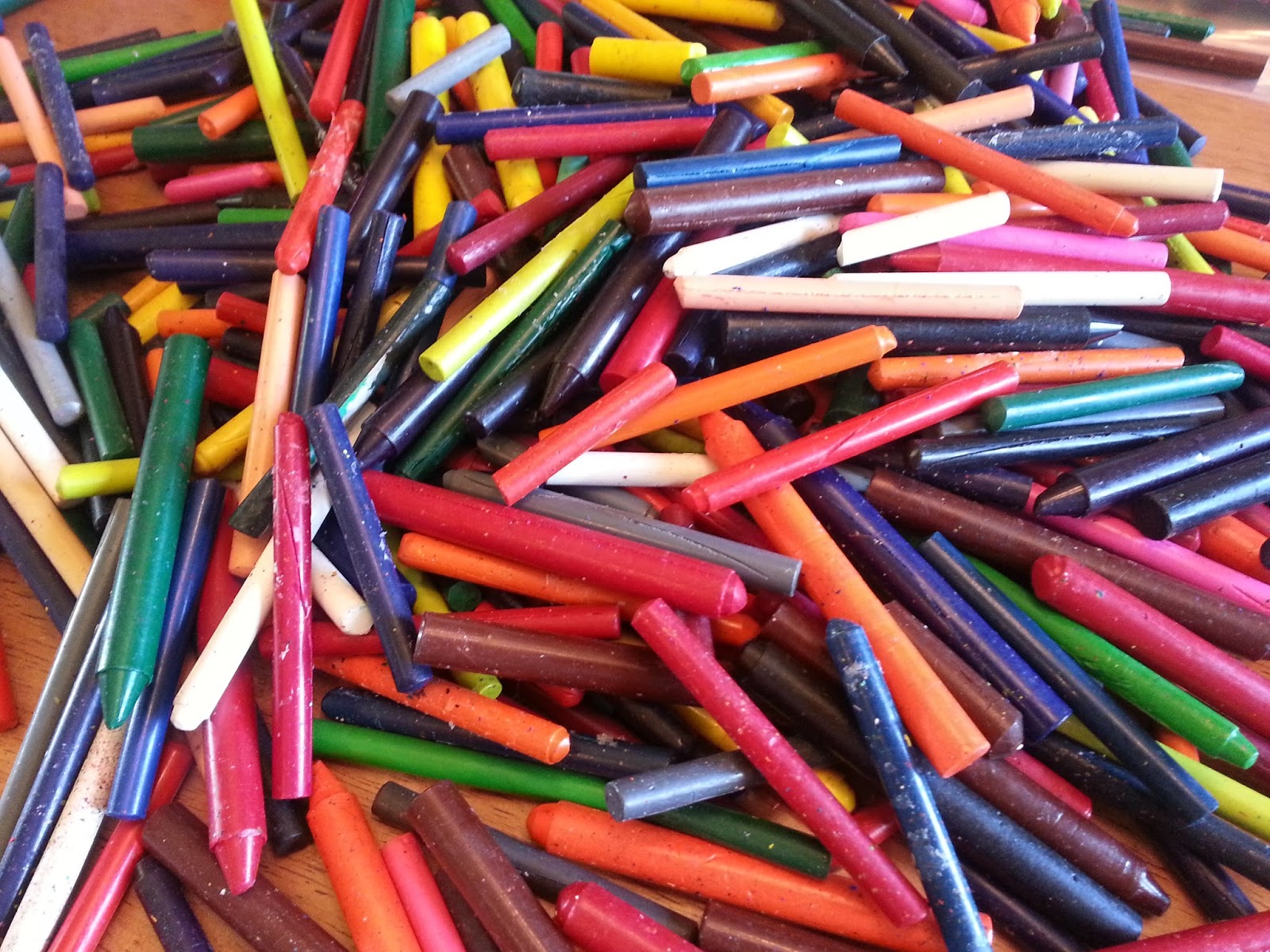

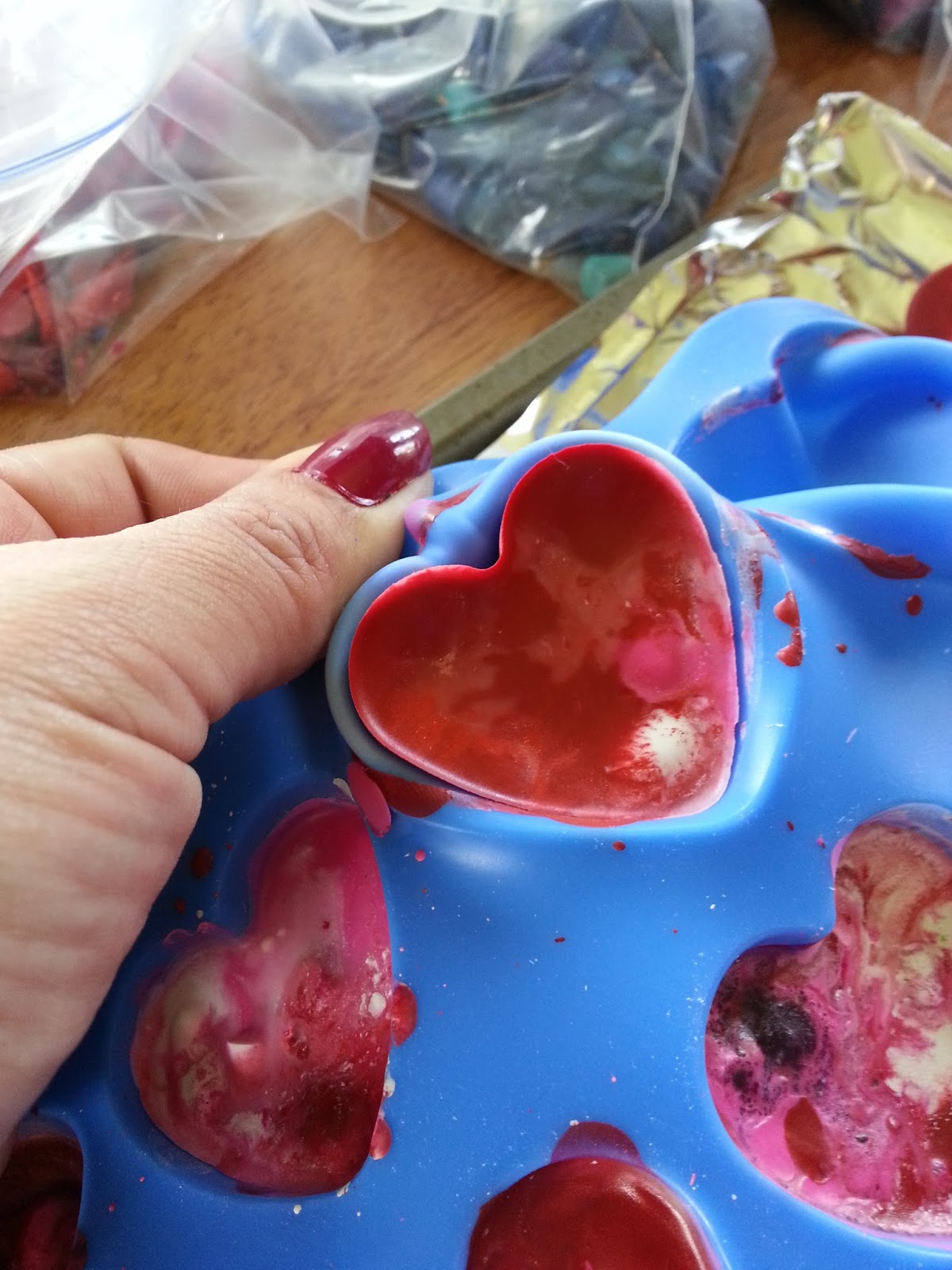
Having an almost fourth grader in my house means that sorting crayons is a quick and easy job.  After looking through the silicone molds that I have, we decided to make star and heart crayons.


I've found great tutorials on making crayons using metal muffin tins, but I like the different sizes and shapes that are available in silicone molds.  I find my molds at Joann Fabric and Crafts or Michaels, and always use a coupon to get them for at least 40% off.  When you're looking for molds, make sure to NOT use plain ice cube trays: you need molds that are oven safe:


You'll need to break or chop your crayons into smaller pieces.  I've found that pellet size, about a quarter of an inch wide works best, especially when you're filling smaller molds.  I put a sheet of parchment paper down over a sturdy cutting surface, and use a large knife to cut same size crayons: I don't try to cut fat crayons with normal sized ones as it makes the knife wobble.  Safety first!


My son and I decided that we'd like our hearts to be red, white and pink.  Cut slowly across each crayon, applying pressure to the tip of the knife, then pressing slowly down as you lower the blade across each crayon to the back of the blade.  No slicing and dicing sous chef action here: s-l-o-w is the way to go.


 Once you have a pile of crayon bits, it's time to fill your mold.  You DO NOT need to use a releasing agent or cooking spray on silicone, but you will also NOT want to use the mold for anything other than crayons once you've used it for this craft. Crayon wax will remain in the mold.  Fill each cavity to the top (or even overfill, just a bit).  When the wax melts, the height of the crayons once cooled will be about 2/3 the height of the original mold.

I line a metal cookie tray with aluminum foil, and then place the mold on top of it.  The foil catches any loose pieces of crayon that might fall or melt onto your tray.


Preheat your oven to 275 degrees fahrenheit. Depending on the depth and size of your crayon molds, baking time will vary from 10-15 minutes.  The heart shaped crayons took twelve minutes to melt in my oven.  Later, we made star shaped crayons whose molds were bigger and deeper.  It took fifteen minutes for those crayons to melt.


 The crayon pieces retain their shape for quite a long time in the oven.  Look how shiny they are!


When you take the mold from the oven, you might find the edges of each cavity fully melted, with chunky bits left in the center.  You can put them back in the oven for another minute or two, but it's fine to carefully push down the center with a toothpick.  You'll see liquid wax fill in over those pieces.


Don't stir or over-mix the wax.  You want the colors to remain intact.


You can let your crayons cool to room temperature, but you can also hurry them along a bit by putting the entire tray in the refrigerator on an oven mitt.  These stayed in the fridge for twenty minutes.


Time to start popping the crayons out of the molds.  The silicone is flexible.  You'll be able to push the crayon up from the back, even peeling back the sides of the mold.


Never fear, the mold will return to its regular shape with some pushes and pokes.  It comes ~this close~ to giving you the same rush that popping bubble wrap does.  Well, almost.


Ready for more crayon bits!


I love how the heart crayons turned out.  Instant valentine treat for my students, or my son's classmates!


I've made star shaped crayons for my students for several years now.  These mold cavities are larger and deeper.  We still stuff them full to the top, making sure that each point on the star is filled.  Remember, when the wax liquifies, it sinks a bit and settles lower than the lip of the mold when cooled, so you want these crammed full of crayon bits.  My son likes to mix the colors in each mold to create marbleized crayons.


These took fifteen minutes in the oven, but were still cool enough to remove from the mold after twenty minutes in the fridge.  Now I have a class set, and plenty of heart shaped crayons too!


Fun-shaped crayons are enjoyed by kids and adults of all ages, though I wouldn't tell a student to "stay in the lines" when using them.  My students love to slide the larger star crayons across white paper, creating a marbleized background for collages.

*****

P.S. The Almost Fourth Grader made Christmas tree shaped crayons for his classmates last winter for their gift exchange using the green mold in the first photo.  He filled the main part of the mold with green crayon bits, the very top with yellow, and the bottom with brown.  Beyond cute, I tell you.


Friday, July 10, 2015

What I've Learned Over Summer Break (So Far)


Sounds like that obnoxious essay we had to write the first week we were back in elementary, middle, or even high school, doesn't it?  I never liked having to write it, because it was much more efficient to just tell friends and teachers that I read books, crocheted, watched t.v., did chores, and then read some more books, no s-t-r-e-t-c-h-i-n-g or "expanding upon a theme" required.

Short.

Sweet.

To the point.

And now that I'm a forty-five year old wife, mother, kindergarten teacher, blogger, crafter, coffee drinker and cookie baker, here I am.

Typing.

About what I've learned this summer.

Oh the irony (which could be the opposite of "wrinkly," in some of my students' minds).

No three page papers, double spaced here though, okie dokie?  A list will suffice.


  • I taught myself how to create slides, posters, work pages and labels via Powerpoint, all by my lonesome.  That's right, now there's a Teachers Pay Teachers button in my sidebar.  Go me.
  • Lurking and even participating in education-related Twitter chats is an awesome way to build and learn from a global PLN.  Once school starts up again, my favorites will likely end up being the ones that post questions in advance so I can set my responses and additional questions into the queue on Tweetdeck to auto-post.  Yeah, I've become THAT tweep.  Thanks #TeacherFriends, #edchat, #ResilienceChat, #G2Great, #KinderChat, #SatChat, #SunChat and #KSEdchat. You ROCK.
  • There's no rhyme or reason to my summer teaching goals except for the fact that they're always related to making my Super Stars' learning environment exciting, inspiring, fun, and safe. One summer I sorted all of the math and ELA manipulatives into easy-to-distribute containers and bags.  Last year I painted wooden toys to eliminate graffiti, er, "environmental print" that a student had added.  I modified inherited storage, making materials more mobile on a rolling cart which helped as my students used every available surface, corner, and hidey hole in the classroom.  This summer, it has been all about the books. Sorting books, donating books, buying books, and creating my longest ever wish list on Amazon.com.  Sure hope Santa or some generous benefactor looks me up and surprises me with them all.  A teacher can dream.
  • It takes me exactly thirty-three days out of school to lose track of what day it is.  Now THAT'S data.
  •  You know how Lucy always freaks out after Snoopy kisses her, dancing around, arms flailing wildly, screaming "Ugh! My lips have been touched by DOG LIPS?"  Turns out I have a VERY similar reaction when I'm outside watering plants and a frog jumps out from the leaves and attaches itself to my bare ankle. And.  Won't.  Let.  Go.  A few more energetic kicks in an attempt to ~fling~ the frog off of my foot perhaps, but the same number of "ughs" and gags.  And flailing.  I've got the moves... like... Lucy.

I learned that last one just this morning. 

Yes, I'll admit I washed my ankle.

Twice.

What have YOU learned this summer?


Thursday, July 09, 2015

Teacher Truth: We Shop 'til We Drop

 Go ahead, ooh and ahh for just a second:


Non-teachers might think that the goodies above have been purchased for a party, and in a way, they're right: the beginning of my 20th year teaching kindergartners occurs in August.  What they might not be aware of is the fact that ~every~ year I've taught I've HAD to make similar colorful, cute, usable, necessary, and SUBSTANTIAL purchases.  I had to build my class library.  I had to feed more than a few students.  I had to purchase items that a one hundred dollar classroom budget couldn't cover. There was a year I bought used iMacs so my students could have technology tools, and another where I created a housekeeping center from scratch.  Educational videos, music c.d.s, my own printer, laminator, storage tubs for organization, paint, colored pencils, google eyes, glitter... I've shopped 'til I've dropped.  

Hunting for and finding perfect classroom essentials can be a lot of fun, until you realize that it's your own wallet making purchases to support 16-30+ students, in addition to the children who may reside with you under your own roof.  We are never done shopping, trading, recycling or making, and as a result many of us become hoarders of:

Manipulatives, reading buddies (stuffed animals), markers, crayons, folders, pencil grips, paper, desk tags, ink, play dough, storybooks, paper towel and toilet paper rolls.  

Shoelaces, spare winter gear (scarves, hats, mittens) and coats, and NOT for dress up bins or dolls, because those, by golly, are kept in their own separate stash. 

Plates, cups, plastic food, puppets, sensory bin supplies, bulletin board trimmer, curtains, pocket charts, measurement tools and tape.  Lots of tape.

Cereal, snack bags, crackers, and juice which are stockpiled ~before~ "treat" purchases like Smarties or valentine lollipops.  Birthday pencils, gift books, supplies for parent gifts, paper, label packs and ink to print off name tags, anchor charts, and organizational signs. 

... and volunteer appreciation gifts, notecards, and "Welcome to School" postcards. 

Manipulatives wear out or disappear over time.  If you're a kindergarten teacher, you regularly encounter teeth marks, bends, folds, and tears.  Maybe you're stuck with a grade level or district-wide school supply list, and you're inundated with materials that you have no need for, but certainly don't want to go to waste.  Two-thirds of your students will come to school with the exact tools they'll need, but one-third won't even have a backpack. You will shop

The more you think about it, the less you see these items as "cute," "fun," or "sweet."  Your professional filter accommodates your utilitarian intentions.  You recycle, repurpose, and rethink furniture, toys, books, and your own child's outgrown clothing or shoes.  You find stores with teacher discounts, and learn to track down coupons and annual sales.  You use spray paint and a glue gun.  You accept any and all donations.  Every year that you're an educator, you'll buy before you teach a single lesson.


(Walmart)


(Target)


(Target)


(Kohl's)


(Target)


(Thrift store, Target)


(Walmart)

Except for the star-shaped chalkboard tags, none of the items above were a "fluff" purchase.  Everything will be put to good use, right down to the last marker that will dry out prior to May, at which point I'll have my summer shopping list ready.

Thursday, July 02, 2015

Perception VS. Truth


Teacher Truth: educators don't sleep in coffins all summer.

We stalk the Target $1 Spot until classroom manipulatives, organization and decor items are unboxed, and then descend upon its bins like a swarm of ... well... teachers.

(Thanks to Bill Watterson)