Showing posts with label teacher reflection. Show all posts

Saturday, May 29, 2021

That's a Wrap


... and that's a wrap.  My 2020-2021 school year is over.  My annual tradition of decompressing at the end of the year as summer begins by reflecting upon and blogging the lessons I've learned is still exerting some pull over me because, well, habits are habits, but goodness... this year has been a doozie. 

I started with twelve "all mine" remote-learning kindergarteners at the beginning of the year, and by the end, finished with seven original Dream Teamers and two mid-year transfers.  In total, I taught forty-eight students, several of them repeat visitors due to multiple exposures to COVID-19.  Because my exposure when Dear Husband tested positive occurred over winter break, my absences from work were limited. The subs I had on those days were brave, turning themselves into instructional hosts akin to Mr. Rogers on the television screen, though I suspect they were glad that I didn't ask them to put on puppet shows.  

I watched colleagues who taught students on-site at the ends of two long hallways empty their classrooms of furniture and engineer six feet of distance between their students while trying to remember to create and maintain distance between themselves and their learners, the absolute opposite of what any of us were trained or wanted to do.  I witnessed grade-level planning happening with team members standing in their classroom doorways, shouting through masks to one another as they collaborated. I saw the encouragement of confidentiality when colleagues tested positive and/or became ill and for the first time in my career, read not only care and concern in the eyes of teachers and staff when they discovered a colleague would be out of the building for two weeks, but fear. Was I exposed to COVID?  How close were we when we walked to the gym/staff lounge to put our lunches in the refrigerator?  I unsuccessfully tried to calm my anxiety every time a staff member forgot to wear a mask, or chose to mis-wear one because their personal discomfort (or belief that COVID19 was a global hoax) was an inconvenience against which they decided to semi-passively rail.  My need for self-care grew exponentially each time my self-preservation button was casually brushed up against. 

I signed many more sympathy cards than in years past as colleagues lost their parents and grandparents.

I eventually conceded to the utilization of a predictable daily routine, complete with scripted Google Slides that were created a week in advance.  Spontaneity just didn't work for families who needed and wanted to rely upon a school schedule that could mesh with their home routine. My remote-learning colleague was wonderful in helping to plan our students' lessons, activities and special crafts a month in advance, and we kept our communication with our families as consistent as possible. We did what we felt was best for both our students and our guest kindergarteners, and I believe our families could feel the care that we put into teaching.  Administrators didn't police us much, but I can't say whether that was by design or simply because we weren't starting any fires.  Having the autonomy to create our own learning program is an experience I doubt we'll ever forget. 

Tech being glitchy doesn't instill panic in me any longer.  Sometimes it's the platform or website that is having an issue.  Sometimes you just have to close out all the apps, shut down the iPad, and let it rest for a few minutes before powering it up again.  After the ninth new update to the operating system installs itself, the day continues, and so does the learning... in most cases.  I'm glad I was able to create digital resources not only for my students but for colleagues in the district who were able to use them in their on-site classrooms, and I will be forever grateful for all of the sharing teacher communities on social media who donated their own creations in kind.  My device and equipment list for the year included: 
  • Laptop; laptop stand (purchased by me)
  • iPads: teacher (it was my second screen for Zoom, displaying my students' faces, and often their parents' faces and backsides, with regular appearances from siblings, pets and stuffed animals) and student (so I could model all apps and step in as an initial help desk of sorts)
  • iPencil: I fiddled with it once but never used it again, preferring to model writing and drawing using our regular writing tools 
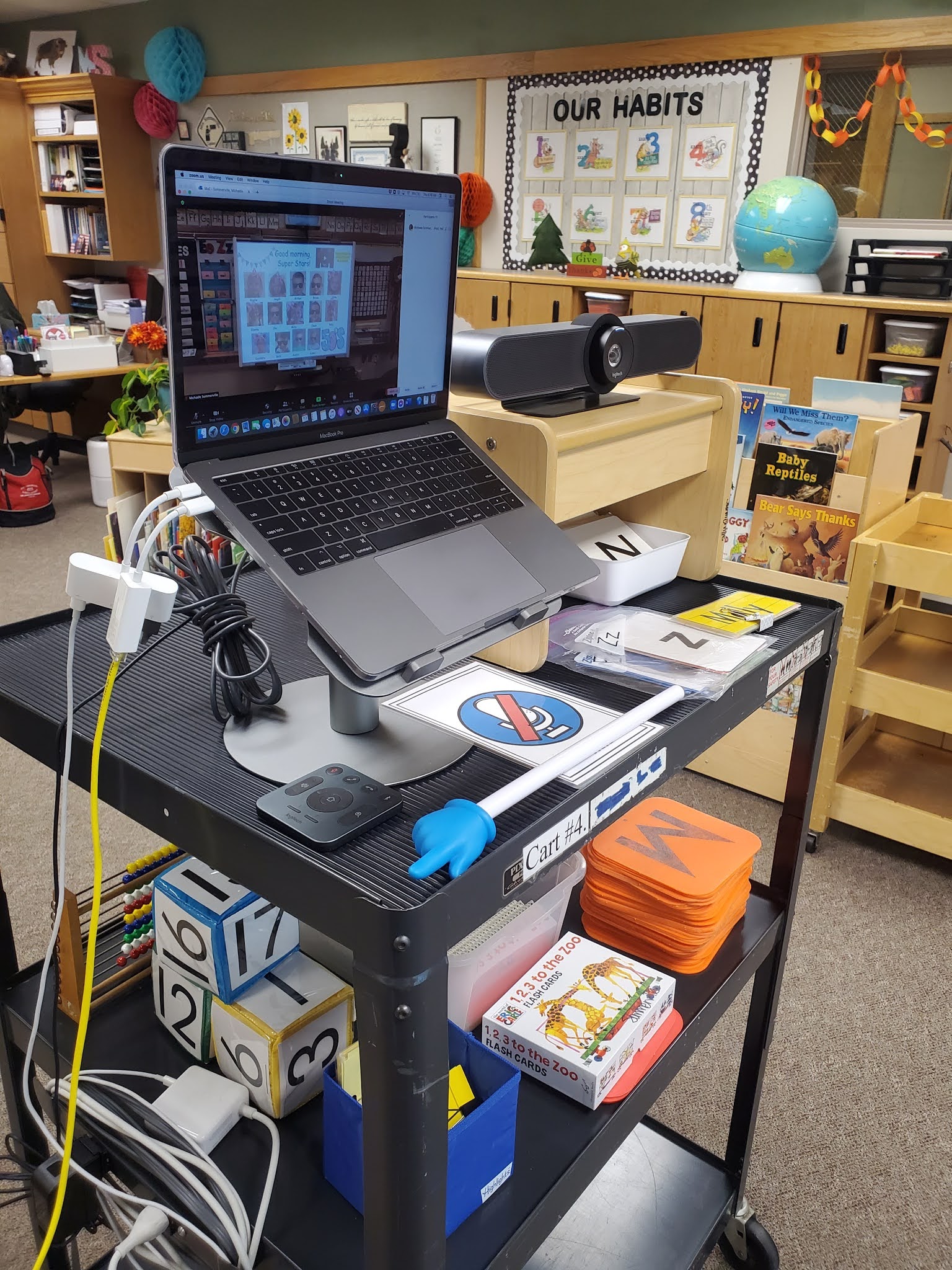
  • Logitech camera, gifted by admin at the Board Office: the extra camera made it possible for me to share other spaces in our classroom daily without giving everyone motion-sickness by carrying my laptop to a new location.  It could pan out to include a view of an entire wall of anchor charts, and zoom in close easily with its handy dandy little remote.  My students were able to see and experience storytime with big books and art lessons modeled by me using a regular kindergarten painting easel. I went from a laptop on a milk crate to a command station pretty quickly:

  • Document camera: for displaying books, worksheets, etc. onto the....
  • SMARTBoard: My daily instructional slides appeared as large as a bulletin board.  Students viewed the board through my laptop and Logitech cameras.  Video content was screen-shared from my laptop via Zoom.

  • Microphone: speakers located in multiple ceiling tiles kept me from having to use my "teacher voice" in locations that weren't within the immediate vicinity of my laptop. 
  • Additional camera (purchased by me) for a desktop computer that I used from my teacher's desk when my laptop was being repaired. 
I know that other remote teachers used fewer devices and equipment than I did, but I just couldn't bring myself to teach in a sitting position all day.  Having my laptop and Logitech camera on an old media cart in front of the SMARTBoard made it possible for me to stand, change locations in the classroom, and share more of our learning environment with my students.

This year became a standalone teaching experience for me, stretching from last March when the stay-at-home order was first issued through yesterday when I signed off of Zoom for the last time with my Super Stars and their families.  Despite some semblance of normalcy provided by curriculum, routine and even decor, I'll admit to having to look through photographs to remember a lot of the finer details of what happened this year.  So much has to be brain-dumped when you're literally trying to stay alive while having to appear professional as you're doing it.  My Super Star Families were gracious, supportive, and (almost all) on board with what Zoom Kindergarten had to be, and my decision to be a remote teacher for my twenty-fifth year in education and their decision to have their children be remote learners for their first year of school were the right ones for us.  I will always appreciate my district providing the remote-learning option that helped to support the health and safety of me, my family, and my Super Stars and their families. 

Even during a pandemic, it takes a village. 


Monday, December 21, 2020

December 2020: My Remote Teaching Reflection


On my first full weekday of winter break, I’ve decided to actually take a break. I’ve been a remote-learning kindergarten teacher (voluntarily) since the start of the school year and have been working through the new normal that has impacted my weekends and family time as significantly, if not more so, than the hours, weeks, months, and years that my master’s degree did. This reallocation of my time has broken years-long habits of enjoying hobbies, repeating patterns of morning, noon, afternoon, and evening rituals on autopilot, and of course, blogging. I need a brain-dump that only reflection can provide, so here… we… go. 

Despite assertions at the end of the last school year that I couldn’t predict the requirements my district would consider and eventually implement to accommodate remote learning opportunities for students and families this year, I’m glad I decided to take part in a summer workshop geared toward virtual/online learning that was recommended to me by a former administrator. Bitmoji Classrooms (which are just really, really busy Google Slides if you’d prefer a simple definition), equity in education, tech resources for devices, platforms, and newbies to it all, digital newsletters, podcasting, and my favorite tool since Pinterest, Wakelet boards, have all been resources I’ve utilized and content that I’ve shared with interested and receptive colleagues this semester. I have added more content to my boards and created new ones whenever I’ve stumbled across useful resources. Building a bank of awesome Linktree contributors has helped prevent me from having to create or recreate every digital activity or material, so that particular board has grown the most. 

Developing and settling into a new groove for planning, collaboration and instruction was a big shift, but one I haven’t had to do alone. Though initially dismayed at having been assigned to an additional remote-learning kindergarten position, my partner has demonstrated determination and has had the energy to put her all into her instruction, our synchronized adjustments each time we’ve gained a student (or six) due to quarantines from on-site classrooms, and frankly, collegiality. Having a co-worker who actually says “good morning” and shares some of the normal goings-on in her life on a daily basis and in turn, listens to some of mine, has helped to make this strange situation easier. She’s a finder and a sharer, an asker and a suggester. Kind people who rock reciprocity are cool. 

Despite my love of educational technology, I’ve always varied the tools I’ve put into my previous students’ hands and learning environment, so following a digital-tools-only mandate was never going to work for me. Suggestions for at-home materials such as math manipulatives have had to run the gamut from balls of Play-Doh, rocks from the neighborhood playground, Cheerios, and Barbie shoes. I’ve used my monthly copy-count only twice over the past four months to create bi-monthly work packets of pages that families shouldn’t have to print and that are beneficial to students. Students at home should be able to assemble thematic unit and holiday crafts just as their on-site peers do and are just as deserving of the magic of memories and keepsakes that are usually made within the confines of a school building. I don’t intend to ask for permission (again) or for forgiveness: providing students more, not less, continues to be the right thing to do. 

Before finding out that my job assignment would be as a remote kindergarten teacher at the beginning of the year, I already knew that new protocols and restrictions would be in place for me and my students. I tried to brainstorm ways to balance limitations with new opportunities, such as alternative greetings to hugs and high-fives, and opportunities for digital collaboration rather than physical partnerships at learning centers or my reading table. For remote learning, opportunities abound for students who are sitting on their couches, at the dining room table, on the floor in the basement, or at a makeshift desk tucked into an alcove in the hallway originally intended as a mud space, though a quick scan of some teacher groups on social media makes it abundantly clear that a lot of other teachers don’t feel the same way when it comes to having very little control over learning environments. While not making light of the issues of poverty, the lack of interest for some families in being the best guide on the side that their child could have, or issues with technology (equal access, availability, and general glitchiness), I have to say that I love that my Super Stars can come to each Zoom session with their favorite blanket, stuffed friend, and even a snack. It doesn’t bother me in the slightest. I have witnessed more awwwwww moments through my laptop camera and iPad screen this semester simply by looking up as I read a story. Multiple frames of five-year-olds hugging blankets and squeezing their stuffed bears, t-rexes, and frilly frou-frou unicorn/princess/octopus whatevers while sucking their thumbs and gazing intently at their iPad screen have stopped me mid-sentence on more than one occasion. And the learning spaces created or adapted for each of them? No one-size-fits-all table, no siree! From little offices or cubbies that resemble clubhouses or forts, to special placemats arranged in a breakfast nook or pillows crammed in a laundry basket underneath a tall table, my students have had a say in the structure of the areas where they have been tuning in. 

My own adjustments haven’t been all sunshine and rainbows... specifically, my own auditory processing issues. While most of my students hear me through their headphones, I hear EVERYONE’S background noises when students unmute themselves, and so do all of the classmates who are captive audiences during instruction. Dogs barking, doorbells ringing, parents loudly managing multiple learners, other teachers’ voices booming from devices used by older siblings in the same room who would rather not wear headphones, younger siblings screaming, spouses teleworking and shouting above everyone else in the next room just to be heard, it’s all excessively jarring and headache-producing. I hear it all at the same volume, which has nothing to do with a knob or setting on a sound mixing board that I can control. And for the only-once-so-far-please-let-it-not-happen-again “I don’t give a SH*T IF YOUR TEACHER CAN HEAR ME! THIS IS MY GOD-DA** HOUSE AND I’LL DO WHAT I WANT” event… well, yes, that one resulted in both a headache and a charley horse as I leaped from the reading table to the rolling cart that houses my laptop and extra camera/speaker in an attempt to “mute all.” My Super Star was mortified, his peers were confused, I was concerned and trying not to scream out in pain, and well, obviously Dad was stressed. Not every hour has been our finest and not every day’s successes have been the ones originally hoped for. 

I miss working in a room full of kindergarteners and their artwork. Not enough to request a return to teaching in-person, though. The same goes for all of the eavesdroppings I used to be able to do every day as Super Stars worked through their daily activities, learning centers, recesses, snack, and instruction within earshot. I miss it but still end up on the receiving end of some kindergarten and parent funnies via Zoom. Teaching remotely while limiting all of our exposure to COVID remains a reasonable trade-off for me. 

I continue to change two of my bulletin boards and some of my classroom décor monthly, even though my Super Stars are likely to never see it all in person. Not putting up bulletin board displays was a line I couldn’t cross. Goodness, I even hang up the results of my own directed drawing activities that my students and I work through during daily writing. Twenty-five years of teaching will do that, I guess. Our classroom can’t just look the part for students, it must feel the part to me


As curriculum publishers scramble to produce quality digital content and a huge gap continues to exist between teachers who find the use of tech devices and resources intuitive and those who feel it beyond their capabilities, I appreciate not only those teachers who share the content they’ve created (either freely or at cost), but those who collaborate in order to customize the resources that will benefit their students. I don’t have to recreate the wheel when it comes to putting Google Slides activities at the fingertips of my students, and I’m thankful that I know how to create my own content as well. But finding resources and putting them into the queue takes a lot of time, time that would have usually been spent in years past preparing materials with a grade level partner, mentoring a first-year teacher, or helping a colleague restructure her learning center organization during prep. Many teachers trying to make the leap from their file cabinets to their touchscreens are experiencing true stress right now, as are their colleagues who find themselves stretched so thin that they have very little left to give to their teammates, especially as they try to keep something of themselves in reserve so that they can make it home with enough energy to make dinner, clean house, and help their own children work through projects and lessons. Teachers in 2020 are finding it near impossible to do “just one more thing” even if heavy loads in years past were made lighter by many hands. There’s a lot not getting done that needs to be done, and there's really no point in priortizing the fascade that we're making everything as "normal" as possible. Sometimes we must dive into the deep end instead of continuing to dip our toes into the kiddie pool, no matter how frightening it may be.  And sometimes, we have to do it alone.  Bless anyone who has done their part to be the waterwings, buoys and lifeguards in education.

My mind will return to school-mode a few days before I return to the classroom as it must if I’m to create graphic organizers such as a weekly plan, choice boards and instructional slides, organize materials and schedule activities in Google Classroom, and frankly, iron clothes for the first academic week of 2021. But until then I am hoping to enjoy winter break with my family and get some much-needed sleep, which is also my wish for anyone reading this post. 

Happy holidays to you. Stay safe, healthy, and hopeful.

Saturday, August 22, 2020

My New Classroom in the Time of COVID-19

I'm a remote learning kindergarten teacher this year.  In my district, this means that I will still report to my school building each day, but will teach students from my classroom via Loom, Google Classroom, and pre-recorded content videos while other teachers' students join them for face to face instruction on campus.  My new classroom is a teaching space that would never in a million years be able to support all of the materials, furniture, decor and experiences that my previous room did, but I selected some essentials that remained with me in the building while everything else was brought home. I hope to be able to mount my laptop (camera) on a swivel stand in the middle of the circle, so as I move from location to location, all I have to do is check for focus and framing, without trying to finagle the right height for my laptop in each location, risking gravity's inevitable assertion.

Here's the "before:"

I've arranged my classroom into three areas.  The first is my instructional "circle," which includes in a clockwise rotation my SMART Board, a reading table, bins full of ELA and math manipulatives that can be displayed via projection provided by a document camera, an art easel for painting and craft table for demonstrations/tutorials, and a big book, calendar and story time area next to a cart that is positioned next to the SMART Board. The second is my office area, complete with desk, second monitor that can be hooked up to my laptop, my bulletin board and curriculum storage, and a large table that I can use to sort consumables, create work packets (hopefully), and spread out curriculum guides or other bulky items if needed.  The last area is the real estate for my bulletin board displays and other visuals such as anchor charts and dry erase surfaces.  

Here's the view from my desk (my SMARTBoard is against the far wall, past the big book stand and storytime easel):

I've been keeping half of the room's lights off and the projector of the SMARTBoard dimmed this past week in an attempt to keep the room as cool as possible.  Even with the help of two oscillating fans, I haven't been able to get it cooler than seventy-three degrees, which, no joke, is almost ten degrees hotter that I like any room to be. There are no quilts or lots of puppets and stuffed animals in my room now because we need to minimize the amount of fabric and other porous surfaces into which I and other visitors to my room may come into contact, but the bulletin boards are prepared and surfaces are decorated as they would be if my students were going to be with me in-person. I plan to photograph our sound wall, a display of our 7 Habits, our sixty Power Words, our math vocabulary wall (it's taped to cabinetry), and the front of our room in case a Bitmoji-style room isn't allowed for reference on a Google Site or in Google Classroom.  Even if our building is closed again like it was last spring, I should be able to use the pictures I've taken as reference materials online. 

To the right of my desk, behind the instructional circle is a long table, rolling cart, and bulletin board/tub storage.  I anticipate this area will end up full of math workbooks, packets, and whatever other resources I might be providing to my students.  Because there's a huge bulletin board in this area, I've put up a sound wall that I can easily photograph for my students' reference.  All of my ELA book tubs are stored within easy reach, though I don't know yet if my students will be able to borrow and use books at home, or if they'll only have access to them digitally.


Though I'm hoping I'll be able to teach effectively for the school year from within this classroom, I'm setting up an instructional closet area at home in my craft room should our buildings be closed again like they were in the spring. Over-prepared is better than under-prepared, right?

This year my classroom won't be full of students or their work, creative constructions, or seasonal crafts.  It will be odd, and even uncomfortable. I'll be hearing other children and colleagues as they pass by my classroom each day and it will be an adjustment to only interact with my own students via a screen with little if any time in each other's presence.  It will be refreshing yet unusual to eat my lunch and snacks and drink my water outside for as many days as it is possible.  It will be uncomfortable, worrying about what might be in the air all around me indoors, and what I might bring home with me each day.

No, I cannot take a year without pay.  I'm at least fifteen years away from retirement.

Vigilance. Grace.  Hope.  Patience. "Preparedness." 

I'm not sure they, or my organizational efforts, will be enough.

Monday, July 13, 2020

Instincts and Urges

It's summer and this is the week traditionally when I would be back in my classroom arranging furniture, freshening up bulletin board displays, pulling stuffed animals, manipulatives, journals, tubs, books and other items from cabinetry and sitting down at my reading table to take a break, eat lunch, and survey the progress.  There's usually music playing through the surround-sound speaker system, my door is wide open for colleagues to come through if any are around, and it's either sunny and hot or storming like crazy outside my classroom windows, making me wonder if I'll be navigating around downed trees once I leave the building. Even last year after my surgery my teenager was able to help me sort through things and prep.  An angel of a colleague arranged all of my furniture so I wouldn't strain myself. 

Last week I got to see a video of my classroom, completely cleaned, and that same old urge automatically kicked in. I wanted to walk back inside, stand immediately within the door, and just look, slowing scanning my room from left to right, up and down, and back again. Bookcase, SMART Board, dry erase board, check. Calendar, storytime chair, book display, ELA tubs, check. Word wall, student chairs, writing table, center toys, check. Apple basket stand for puppets, dramatic play kitchen set, baby doll cradle, math bulletin board, check. Bookcase, round math table, manipulatives, rolling cart, check.  Art cart, desktop laminator, paint, glue, crates of craft mock-ups sorted by month, check.  Easel, play-doh table, carpet, sink, paint rack, Pete the Cat sitting in a wreath gifted to me by a Super Star family, check. Handwashing station, birthday bulletin board display, and way up high, above all of the built-in cabinetry, tchotchkes and keepsakes accumulated from over two decades of teaching in Alaska, New Mexico, and Kansas... check.  Door to a shared workroom/storage space, teacher desk, cabinetry, student lockers and cubbies, dollhouse table, check.  Rolled up carpets and students' tables stacked, rolling cart used for storage and at the end of each year- except for this year- yearbook distribution... check. Hooks hanging from clear fishing wire.  Check. I can imagine the laughter and buzz of students talking as my eyes track across our spaces.

I have also had the incredible urge to walk back into the classroom, empty all of the furniture into the hallway and shared space at the rear of the room where the bathrooms and iPad carts are located, measure out the actual floor space, and start pulling tables and chairs back into the room to measure some more and get a feel for what six feet apart all facing the same direction feels and looks like.  Tables and chairs have been in a wagon wheel or flower petal arrangement for several years now, which can't happen now. My go-to, when faced with a problem or situation requiring modifications and solutions, is to move furniture and be creative, taking inventory of what I have, and imagining new ways of using it all.  I've been watching all summer and have been seeking out photos and information about schooling and classroom arrangements shared by teachers from all around the world.  Articles and tweets about the happiness of being reunited with students, the smell of disinfectant permeating the air and face coverings, the adjustment being more difficult for adults than children and the touchy-feely declarative posts of "I just have to be here no matter what" do nothing to reduce my urges to cry or feel nauseous.

I've wondered if plexiglass dividers would work across the middle of each of my student tables, and should they be too expensive if creating dividers using clear shower curtain liners, PVC pipe and foam strips for a gasket-type seal would serve instead. I've wondered if I need to replace the fabric curtains that cover most of my lower cabinetry with vinyl or plastic of some sort, so they're easier to clean.  I've purchased Ziploc baggies with sliders and plastic lidded containers with divided sections of various sizes to see if they'd be efficient and easy for kindergarteners to access and store math manipulatives daily.  I've priced individual book totes in anticipation of students not being able to select, share or trade books to look through. I've purchased new tongs, long and short, for selecting items from bins without using our hands and for picking up the tissues, disposable masks and other garbage that will end up on the floor or left on desks.  I've tried different masks and bought safety glasses to see if there is any combination that isn't overly uncomfortable, sweat producing, or too scary for young children.   I've bought masks with our school mascot on them.  I've ordered new sit spots shaped like stars and colored carpet tape for delineating spaces and suggesting traffic patterns.  

Despite all of these deeply ingrained habits and urges, my instinct, just as it did in May, continues to tell me to stay away from the classroom.  Guidance about social distancing aside, it's always been my job to create a learning environment that appeals to young children, that communicates our classroom is a safe space to which they should want to return day after day and that parents also find reassuring.  I could shift decor and manipulatives to all laminated, disinfectant-friendly items.  But the safety implied, if it could effectively be so without our puppets and stuffed animals and shared spaces and hugs, would be a lie.  Acting-as-if and putting on a brave face aren't markers of professionalism during a pandemic, despite society believing them sufficient in the case of fires, tornados, earthquakes and school shootings.  

It's not lost on me that my money might have been better spent on purchasing a large dry erase board to help set up space at home from which I could teach, no masks required.  But as usual, my instinct and urge have been to anticipate and prepare for the worst while hoping for the best.  I just wish the worst wasn't so very, very bad this year.


Thursday, July 09, 2020

An Educator's Code of Conduct

I've spent my summer participating in and learning a lot from an online teaching workshop (about online teaching and remote learning, of course), growing cucumbers, cherry tomatoes, and bell peppers in my greenhouse (melons, cantaloupes and pumpkins are just starting to take off), keeping up with household chores, crocheting and reading.  As I surf social media, I find myself intending to sift through but often drowning in updates, news, and opinions expressing not only how we might safely open schools this summer, but IF we should even try until winter, or spring...or next fall.

Watching and listening to the President, the Vice President and the Secretary of Education, none of whom could teach their way out of a paper bag (if they even know what a paper bag is) insisting upon our schools opening sooner rather than later at full capacity, just-throw-them-into-the-deep-end-of-the-pool-without-floaties-and-they'll-either-sink-or-swim style is something I find maddening.  I consider this an incredibly appropriate response because it means I'm neither numb nor indifferent to the responsibilities of my job: I am a kindergarten teacher.  I am a mentor.  I am a colleague.  I am part of a district team, and our shared goals are to educate children, guide them, and support them in the hope that they develop a love of learning and many talents that will help them live what we all hope will be long, happy, illuminated, creative, purposeful, giving, inspiring, joyful, healthy lives.

I'm an early childhood advocate and I'll be starting my twenty-fifth year of teaching this fall which should make it fairly clear that I'm committed to much more than my paycheck.  I love teaching.  I love coaxing unsure children and families into larger learning communities and watching them blossom and grow as they make friends, broaden their understanding of the world, all while being safe, kind and helpful along the way.  I love doing the voices of characters during storytime.  I was an anxious and insecure child, which is perhaps why I cannot contain my pleasure and awe as I watch my Super Stars explore and share freely, considering it a success when their use of me evolves from wanting me as their training wheels to simply going about their business with confidence and purpose while still considering me good company. Parents' heartstrings are pulled when they realize their children don't need them as much as they used to, while I revel in seeing how far my students go after our time together.  I've reported parents to Child Protective Services and I've encouraged families to seek out counseling and help, all as an advocate of children. "My kids" aren't mine because I'm some sort of surrogate parent, they're mine because of the affirming relationships and experiences we had during our time together, even if some of them weren't fun.  I have been and continue to be invested in not only their academic success but their well-being.

This morning, after reading through tweets and posts volleying back and forth debating teacher responsibilities, parent needs, and the disparities between state and national agencies that can't seem to get their stories straight regarding school openings, I thought it might be interesting to check back in on my state's Educator Code of Conduct.  Have you read your state's guiding educator document?  Mine is divided into three components, beginning not with responsibilities to my district or the profession itself, but to my students. I cannot help but believe that this is by design: children, our students, must come first.  Responsibilities to students include:


"Make reasonable effort to protect the student from conditions detrimental to learning, health, or safety." 

"Nurturing the intellectual, physical, emotional, social and civic potential of all students."

"Fulfilling all mandatory reporting requirements for child abuse."

"Fulfilling the roles of mentor and advocate for students in a professional relationship."


Inappropriate conduct includes "committing any act of child abuse."

Recall that "child abuse" is defined as physical, sexual, and/or psychological maltreatment or neglect of a child or children, especially by a parent or a caregiver. Child abuse may include any act or failure to act by a parent or a caregiver that results in actual or potential harm to a child, and can occur in a child's home, or in the organizations, schools or communities the child interacts with.


Educators should understand that these responsibilities have been articulated not as suggestions but as requirements. We must protect children from anyone or any situation that may hurt them.  I would like to believe that students are listed first in the Code of Conduct not for sentimentality's sake or to advance public relations, but because a commitment to them must be prioritized.  I don't see how we can allow ourselves and others to pretend that schooling, education and child protection should take place as usual with possibly insufficient modifications touted as "protection," ignoring that we're in the middle of a global pandemic. COVID-19 is a potentially life-altering, deadly virus that we're still learning about.  Trying to convince others that it's a hoax, pretending that if we just turn off the television and unsubscribe from news alerts that all of this will just go away is irresponsible. So too, are punting and not-so-blindly hoping that our gamble will pay off as we "act as if" we're able to safely maneuver around a virus that may be transmitted in aerosol form in classroom settings.  NASCAR won't even allow adult spectators who choose to observe social distancing into an open-air venue and many colleges and universities will spend the next semester or year only delivering content online.   Fake it 'til we make it isn't good enough, and hoping isn't an actual strategy.  Inventing "solutions" that from the outside appear creative, proactive and even entertaining, such as the pool noodle hats shouldn't actually convince anyone that schools will be safe enough.

This summer, like spring, has been overwhelming for us all. No matter how tempting, don't sit at home waiting for someone else to come up with a way forward that sounds doable to you.  Check your state's Code of Conduct for Educators, articulate your intentions and purposes as a teacher, and find a way or better yet, several, to contribute to the health, wellbeing, and safety of your students. Putting them first might require that we teach remotely even if our spring baptism wasn't all we had hoped it would be. Don't expect to have closure this weekend or at the end of the month.  We may not even get closure if we're back to brick and mortar, settling into a new routine when COVID-19 reminds us that we're on its timeline, not ours, and sends us all back into lockdown.  We're going to be uncomfortable, and frankly, we should be.  No one should be sleeping easily over the decisions we're trying to make, because we're the guinea pigs in the experiment that will create a data set from which future decisions will be made... unless we choose an experiment with a far less harmful and much less deadly possible outcome.

Sounds remarkably well aligned with my code of conduct, come to think of it.  How about yours?


*****

I did not specifically mention accessibility, home abuse/neglect or inequality in education issues in this post because I'm assuming educational professionals are already well-versed in how they weight either side of the scale of school and other societal responsibilities.

Saturday, May 23, 2020

Pandemic Teacher Summer Day 1: It's Time to Play in the Dirt

Yesterday I wrapped up my twenty-fourth year of teaching with one last visit to my school building (I had to deliver some yearbook payments that had been hastily grabbed from my mailbox on the day teachers were given a half-hour to grab essentials to help facilitate instruction from home), helped a fellow teacher take down her twinkle lights so she can transfer to another school in-district (we wore masks and I re-rolled the LED strands from six feet behind her), planned a very tentative instructional schedule with the remaining members of our grade-level team (two have left) during an informal and productive Zoom meeting from home, wrote and sent my last weekly newsletter to my Super Stars and their families, and held my last parent-teacher conference of the year before dinner, three hours after I technically stopped being my students' "official" teacher. A few last teacher-appreciation gifts made me smile:


This morning I woke at my normalish time, made coffee, and checked to see if there were any education Twitter chats planned but found my regulars on break for the Memorial Day weekend. For the past few years I've enjoyed #satchat and #sunchat get-togethers as transitions to the beginning of my summer break, but this year it seems I'm to dive right into my end-of-the-year reflection.  I reread my self-check from the start of the year and found all of it to still ring true.  The raw feelings of my last few posts since the stay-at-home order have started to heal and fade, and I remain determined to find some semblance of balance between my professional and home lives as I look forward to spending quality with my family, tending the food and flowers growing in my greenhouse and taking online courses addressing the creation of effective online teaching and content creation. No, no "summer off" for this teacher.


I'll update my district web page so that parents of my next class of Super Stars who go searching for sneaky-peeks into our classroom this summer are greeted warmly, and I'll undertake the Herculean task of cleaning up the desktop of both my school-issued and personal computers. I created so much content and didn't sort it effectively as I went along, and I don't want to risk throwing it all away with the possibility of still needing it during the upcoming year.  I already took down the classroom props and essentials in my craft room to return it to what I hope will be a comfy and cozy creative space for my continued hobbying.  I'm working on two afghans, plugging along on my goal of crocheting at least one big blanket per month. Last night I took a long soak in the tub and began reading Neil Gaiman's The Ocean at the End of the Lane.


My family and I plan to continue to stay at home as much as possible and to socially-distance ourselves if and when we have to go out to run essential errands.  Masked people are my people, but I've noticed far too many children, who, while accompanying their parents, cower in fear, like many kids do when faced with something or someone scary, as they encounter me in an aisle, or see me sitting in my vehicle waiting for my pick-up delivery.  Some families aren't preparing their children for this new normal, so I anticipate creating and sharing content to help normalize mask-wearing for future students. If I see one too many "prevent the summer slide" or "fill curricular holes created by the pandemic" advertisements or even blog posts by fellow teachers, I'll probably get all ranty in an attempt to explain how no, children don't really shake their heads and erase everything they've encountered and explored like an Etch-a-Sketch pad, and yes, play really IS the best way for them to develop their awareness, knowledge, and interest in this world.  Though I really would have enjoyed a longer break from taking college courses, the workshop I've applied for was frankly irresistible, since I'm a just-in-case person.  With the likelihood that I'll need to continue to reimagine and modify my future students' learning environment, I want more resources and inspiration to help me creatively problem-solve.

With year twenty-five on the horizon, do I hope to remain a kindergarten teacher for the rest of my career?  No.  I would like to become a library media specialist and am waiting for the all-clear so that I can reschedule the taking of my PRAXIS.  I'd pack up my teaching belongings in a heartbeat if I were offered a library in my district, even during a pandemic. Thankfully, I'm not feeling like a reluctant kindergarten whisperer: a year (or a few more) working exclusively with young children and their families doesn't fill me with dread- I will love them forever.  But I do rather feel like I'm on autopilot, and my spirit is chomping at the bit for a new challenge and adventure in education. It's not abandonment or burnout, but a continuation of change and growth, and its possibilities excite me. Shouldn't we all get to feel that several times during our careers?

This year's class photo (and yearbook, when it finally arrives) will get filed away with the others from all of my years of teaching but will stand apart, no matter what. I can only hope that my students and their families, and my colleagues with whom I've traveled and taught over this quarter-century remain safe and healthy. But for now, it's time to go play in the dirt.


Thursday, April 23, 2020

Reflection: Mentorship and Pencils During COVID19

COVID19 has certainly been effective at throwing all sorts of systems and semblances of normalcy out the window.  Creating new teaching environments, using new communication platforms and tools and completely reorganizing our days and routines are pretty weighty changes to experience in a short amount of time.  While I wrap up week four of "instruction" and collaboration and problem-solving with all of my colleagues, be they grade-level or building teammates, building and district administrators, special education and other support staff, I know that some folks within the district are likely already beginning to anticipate any needs that parents, students, teachers and staff might have come the fall semester.  Long-range planning happens every year, whether there is a pandemic or some other hurdle in play or not.  No matter when their stay-at-home orders were enacted, other schools and other districts have started to do the same.

During many past springs, I pencil-planned for the upcoming year as soon as the finalized school calendar was published. I pencil-plan rather than ink-plan because I know that events will be rescheduled and our calendar will change.  I'll find new resources, experience new jolts of inspiration, and have to be flexible for unanticipated accommodations. Nothing is set in stone despite the hope that everything will, in time, go according to the way I had both intended and hoped.  Using a pencil indicates that it's a rough draft, the version that precedes the working draft.  For many years the working draft got its fair share of White-Out dabbed across its pages, simply because I liked the glide of ink over the abrasion of pencil. Nowadays, I simply double-click on text, delete it, and revise data within the cell. Knowing that changes will inevitably happen has never caused me to rethink the merit of pencil-planning. It's another way for me to mentally map the foundational pieces I need and plan to implement for my students' benefit.  I doubt I'll ever choose to fly-blind just waiting to be "surprised" during back-to-school PD. I can be informed now and pencil-plan so that future mandates don't throw me against the wall in August.  

As the most veteran member of my grade-level team, and despite having missed the beginning of the year with them thanks to my late-summer surgery and extended recovery time, I am both formally required to act in a mentorship role and personally feel responsible for making myself and my experience regularly available to my colleagues.  I have expanded my PLN over the years to include groups on Twitter and Facebook, and I have been fortunate to meet and learn from all sorts of wonderful early-childhood educators, college professors and library media specialists during my career and master's program.  When I'm asked for help by a teacher in my building or one five states away via social media, I try to make sure to preface what I share with "use it or don't," so that my PLN can cherrypick the best of what I might be able to offer them while hopefully feeling the autonomy to make their own choices and to innovate, rather than pressure to comply and risk becoming a cookie-cutter teacher. I also believe in playing the role of devil's advocate in order to broaden thinking.  Affirmation, agreement, and the feeling of being a contributory component of a trusted partnership where ideas can be shared, explored, or simply explained are essential emotions for members of any team or purposeful group to experience.  I believe that a common goal for teams should be to balance harmony while avoiding tunnel-vision because being repeatedly blindsided by information that could have been shared earlier but wasn't results in wasted time, increased frustration, and eventual mistrust.  Whether lurking or being actively involved in these conversations, I reap the benefit of diverse perspectives and the experiences of others.  I am a mentor and "mentee," a colleague of other educators.

Working from home I still feel like I must operate within dual roles as I teach, collaborate, plan and share.  I'm a colleague who is not only a kindergarten teacher, but the yearbook producer for the school and the moderator for the professional development points requests that teachers submit towards their re-licensure.  I don't respond in philosophic terms to inquiries about the cost of yearbooks, whether or not I have a piece of writing paper that I can scan and share as a template, or the number of points needed for a fifth-year teacher without a master's degree to renew his or her license. However, when colleagues new to teaching and/or new to our building and district ask for a heads-up regarding what to expect from an upcoming grade-level district meeting, or need clarification so that they better understand the shift from academic grading to marks for engagement, my role as mentor requires that I go a bit deeper, and invest time to not only offer the reasoning behind answers and explanations, but to really hear their concerns and worries, too. This can be a highly emotional, intense component of mentorship, especially for someone who empathizes with others.  To me, there is a distinct difference between the nuts and bolts of teaching and the soul of teaching.  As a colleague, I can hand you a ream of construction paper when you've run out.  As a mentor, I can suggest different ways of using it to benefit your students when you ask or express an interest.  Both responses are helpful within their constructs and contexts.  Dictating "you shoulds" or steamrolling others so that they can't learn how to collaborate (though they might feel relief at simply having the decision-making taken out of their hands) are not ways aligned with serving the profession.  Teaching is full of emotions, and not just for the students. Sharing, patience, inclusion and authenticity are essential ingredients to successful mentor/mentee relationships, not to mention team-growing.


Having to try to teach remotely isn't a choice I, or many others, would have made, but wanting to do it as well as I possibly can remains my intention. I hoped to be both an effective colleague and mentor during this time too, but at this point, I feel like I'm failing at giving my immediate colleagues and some distance-edu-friends what they want or need.  None of us is operating at one-hundred percent, and we all react differently to stressful situations.  Issues that have arisen likely wouldn't have become issues at all if the status-quo of our daily instruction with students within our classrooms had been maintained and COVID19 hadn't come along.  We're not all in the same boat, and even our storms differ.  Perhaps some need me to metaphorically just hand them a ream of construction paper, despite the fact that their questions and assertions resemble requests for guidance and/or context.  Compounding this uncertainty for me are *of course*  my old standbys: for one, I can't "hear" another person's tone within an email and rely heavily upon the use of emojis and gifs (score one for social media where emojis reign supreme).  Not many people have the energy, inclination or patience it takes to find the wink, the laughing out loud, or the thinking faces right now, or maybe they're just not considered professional. Secondly, I continue to falsely assume that politeness and consideration will be reciprocated in return for my efforts.  Not everyone says "thank you," during a pandemic (another point for social media where showing appreciation continues to be considered proper etiquette), so I remind myself that it is those with whom we are most familiar that we should afford the most grace, especially when it's for something as simple as forgiving a social faux-pas. After dipping my toes into the ponds and streams of Facebook and the lakes and oceans on Twitter, I'm confident that there are many other teachers across the nation and in other countries who also find navigating their colleagues' emotions a wee bit tricky this month. Perhaps a gross generalization would actually be appropriate for this moment in time: none of us is getting what we hope for right now. 

After four weeks of remote learning, thirteen years in my present district, twenty-four (twenty-five?) years of teaching, and with a nationwide PLN at my fingertips, I still feel both able and inclined to pencil-plan this spring, just as I've done almost every year.  I've worked ahead to curate, create and schedule content via Seesaw, which has afforded me extra time for other pursuits and chores.  Because I've purposely sought out multiple news sources, surfed and chosen to read information shared from teachers in other districts and states regarding their immediate and future proposed solutions to closed schools, and have tracked the daily updates from health officials (I'm ignoring politicians who are advocating for the economy over problem-solving that will save the most lives) that have made it clear that we are, in fact, 1) presently both lab rats and human test subjects and 2) that it won't be safe for us to "return to normal" until we have a vaccine that is at least a year away, I've set myself the task of envisioning what remote learning might look like in August and September (and October, and November, and February, and April 2021). So when questions from colleagues near and far arose this week regarding possible changes and tweaks to the present emergency based technology-heavy format for delivery of instruction, I suggested that any and all continued fine-tuning might reflect not only a current but possibly future need as well: there's a significant chance that we will not be returning to the classroom as hoped for in the fall.  Can I articulate whether my response came from colleague-me or mentor-me?  Not really. Can I unequivocally say that I didn't intend to cause additional stress and worry when I shared my thoughts?  Yes. 

Suffice it to say, I now realize that many teachers are not ready to pencil-plan or entertain possibilities for next year.  Perhaps they don't plan to return and are focusing all of their time and effort into making their last weeks of remote teaching the best that they can for their students and their sanity.  Perhaps their boats and their storms have them planted squarely in the middle of the fiercest fight of their lives and their immediate needs require that they invest all of their time and effort bailing water from their vessel.  Perhaps they prefer the top-down approach, believing that their "circle of control" (yay, ontological coaching, my favorite), is solely dependent upon the decisions of others, so they'd prefer to not do anything at all until an administrator tells them to.  I can admire their perseverance and any commitment they have made to be the best teachers for their students possible. I can empathize with their fear, and sympathize deeply with their pain, with full acknowledgment that it's not just students who have to "do Maslow before Bloom."  No, I'll never advocate that teachers completely hand over the reins of education to administrators and politicians, no matter how much I appreciate all of the "good" ones.  While I believe it's prudent to start the work of tomorrow today, or at least soon regarding the next school year, I understand that not everyone feels the same way for a multitude of reasons. 

And it's here, with these most passive or even resistant of educators, that I find myself feeling neither like colleague-me or mentor-me, but instead wanting to channel Chrisjen Avasarala, a character from one of my favorite science fiction series as I choose to concede (slightly) with this:

"Well, we disagree. One of us is wrong. I think it's you... but I hope it's me."

I hope a true miracle presents itself that enables us to get back to business without fear for our health, or the health of our families, students, colleagues, and neighbors, soon.  But until then...

... hand me a pencil, will you?


Tuesday, April 21, 2020

How are you doing? What are you doing?

Fellow educators, how are you doing?

Me... I'm still in the process of establishing a new daily routine.  The stay at home and help my teenager adapt to his new schedule routine. The stay at home and help my teenager adapt to his new schedule while connecting with students and families routine.  The stay at home and help my teenager adapt to his new schedule while connecting with students and families at the same time I'm doing laundry and disinfecting frequently touched surfaces routine.  The stay at home and help my teenager adapt to his new schedule while connecting with students and families at the same time I'm doing laundry and disinfecting frequently touched surfaces in between learning new digital platforms and creating content to be posted to those platforms routine.

The do-all-of-the-above while attending multiple Zoom meetings, and then, when the videoconferencing is done for the day, sewing masks for the family routine.


For me, the hardest of all has been the do-ALL-of-the-above while reminding myself often that everyone is free to have their own opinions and coping mechanisms and latitude in how they express their emotions, even when it's in not-so-nice ways and inflicts additional stress upon everyone else while we're calling it all "granting grace" routine.  There's a very good chance you know what I mean.  Not everyone rises to the occasion.  There are even some who refuse to try. 

Yes, there are folks whose stay-at-home routines include health issues, and the loss of friends and family and security and safety.  I can't let myself wallow in either empathy or sympathy simply because I'd feel like I was drowning in sorrow. I experience it, affirm that I am still a human being, and then put it aside.  It's how I continue to function semi-effectively.

What are you doing?  Have you annexed some part of your living space to serve as a makeshift backdrop for your time with students? Are you scrambling to learn Google Classroom, Seesaw, Loom, or some other such thing?  Have any of your pets, children or spouses "crashed" your video recordings or meetings? 

Thankfully, my recent Master's Degree in Educational Technology has already served me well by planting my feet directly upon the baseball diamond, rather than on the edges or barely within the ballpark itself.  Seesaw, Loom, Zoom, and creation tools such as PowerPoint are intuitive for me, but I know they aren't for many other teachers.


Whether I'm recording "good morning," storytime, fingerplays and songs, instructional, or "goodbye, see you tomorrow" videos, or attending grade level, building or district Zoom meetings, Tish-Tish chooses to join me, enabled by the fact that my teaching backdrop is situated within my craft room downstairs affording her easy access.  Teachers in my district were able to retrieve essentials from our classrooms, our choices guided by the Kansas State Department of Education's Continuous Learning Plan. I brought home my document camera, manipulatives, some recognizable classroom charts and lots and lots of storybooks that have been stored on a bookshelf and in tubs on the floor near my desk.


I was also able to rescue plants from my classroom and grabbed some other decor to catch my students' eyes, though the wall of yarn was a really big distraction for the first few days.


I've worked ahead, creating ELA, Math, and social-emotional content four days in advance in an effort to avoid the frequent internet outages that take place in my neck of the woods. Reading and recording a story the day that it's to be enjoyed by kindergarteners is a gamble I'm not willing to take. Has it helped that my internet provider was bought out at the start of the pandemic and is now owned by a company whose customer service has yet to yield an actual human being with whom I can interact in real-time as I inquire about my account and service?  No, not so much.  I know, they're experiencing the same difficulties we all are. 

If only we'd had, oh, I don't know... advance warning that this type of situation was on the horizon.  But I digress.  

I've found humor and joy in the little things, like drinking my coffee out of previously not-appropriate-for-school mugs:


... and lending my smiling face and a sweet sentiment so that a colleague could create  a "we miss you" video for all of the students in our school:


 I've also discovered new things about myself, such as:

1) I'm not a pajama-wearing teacher even when I'm at home.  I'm a business-on-the-top-and-yoga-pants-on-the-bottom professional. 
2) I have never wanted sneak peeks into my colleague's bedrooms, especially not during meetings.  Didn't have to worry about that until now.  As it turns out, I still don't want sneak peeks into their bedrooms.  I don't care if you're comfortable rocking your best bed-head hairstyle, just do me a favor and choose to flaunt it while you sit at your dining room table or out on the back porch during our meetings, okie dokie?
3) I'm not a big fan of motion sickness, which is probably why I've never enjoyed videos featuring hand-held videography or subjects who insist on always being in motion. Lordie, people, put the device down on a sturdy surface and plant yourself in front of it. 
4) I go into withdrawals when I don't have access to my students, our routine, our schedule, our laughter, our... us-ness. It's not pretty. 
5) Though I'm a kindergarten teacher, I would love to do read alouds for upper-elementary and middle school students.  The Girl Who Drank the Moon would be the first book I would read and record for middle schoolers if I had the opportunity.

*****

I hope you're well, and that your friends and family and co-workers and neighbors are experiencing good health while exercising good judgment.

As for me, Tish-Tish has decided it's time to collaborate and sort through activity pages for next week, and I'm not one who tends to argue with administration.


Thursday, February 13, 2020

My Social Media Use Continues to Evolve as I Ask Myself: Is it the Truth or Confirmation Bias?

One might think that by being a kindergarten teacher, I wouldn't have any concerns regarding content shared via social media aside from protecting students' and colleagues' identities and avoiding posting unprofessional photos or tweets of myself.  But as social media algorithms continue to promote what's shared the most, and lies (*actual* fake news) continue to go unchallenged and are shared ad nauseam, the truth, of which I am a fan, becomes harder and harder to find.  Authentic, transparent, and occasionally painful, the truth helps us to become better navigators of our lives. As a teacher, the truths about children and how they develop, rather than the selling points of edu-brands and promises of education reform initiatives have guided and helped me to grow my pedagogy.

I've taught for a quarter of a century, so I can find the humor in teacher memes.  I have snickered, giggled, and admittedly guffawed at some of them, and have even created one or two myself. When I began to encounter some rather tasteless memes regarding teachers and our jobs, where the humor was being pushed toward titillation rather than truth, I incorrectly assumed that the masses wouldn't care, and would certainly recognize the rhetoric as entertainment rather than fact.  My humor didn't have to be their humor, to each his or her own, after all.  But as I watched the outrage that began to attach itself to these memes, and even the embracement of the naughtiness of the not-quite-true content, the thought began to nag at me: rather than fading, these misrepresentations were spreading like cancer, superimposing themselves upon the architecture of public education just as they would the cells inside a healthy human body, damaging, then destroying it.  Upon deeper reflection, I realized that my career and students have had to endure No Child Left Behind, Race to the Top, and now "failing government schools," all big-business initiatives, labels, and election-year rhetoric primarily created to manipulate how the public views this profession, while creating the appearance that the government sincerely cares about quality education and how children are taught in schools.  Voters consumed headlines about NCLB, the Common Core, and Race to the Top initiatives like they were Skittles.  How many will now eagerly gobble up "failing government schools" simply because they don't realize they are trapped by their own confirmation biases (and blind trust) masquerading as truth?


Memes and other content don't magically appear out of thin air. When I created the one above several years ago, I had to log onto the eCard site, choose a suitable illustration, figure out how to make my text fit, and hit "publish." People apparently liked it a lot, recognizing and sharing the humor of my sigh-of-relief declaration that there are no photos of me holding the clammy hands of a boy during PE in the 1970's.  Fine... maybe MY hands were the ones that were clammy.  But more and more often, rather than illuminating the art and hilarity of teaching, or commiserating with other teachers about the ups, downs, laughter and tears of our profession, the memes I was encountering were becoming the newest weapon for those who would continue the attack on teachers for their own economic benefit. Other professions and groups of people are regularly targeted as well, which made for an onslaught (ugh!) in all of my feeds because of how diverse (yay!) my friends and those I follow are in reality as well as digital-land.  In trying to find a compromise so that I wouldn't end up tossing the baby out with the bathwater regarding social media (there's so much that I do want to see and share, despite the content I find misleading and unsavory), I first chose to unfollow a whole bunch of folks. On FB it was friends, colleagues, families of former students, strangers, and even family members, though they all remained contacts. On Instagram and Twitter, it was acquaintances and strangers alike. Unfollowing people on Instagram and Twitter yielded almost immediate relief, frankly because I wasn't closely connected to most of them, and because unfollowing removed them and their content entirely.

The hard work came a few months later when I had to challenge my ideas on how I wanted to use FB, rather than how FB wanted to use me (thank you grad school and Digital Minimalism). Was I okay with clothing and cute shoe businesses knowing what I like and don't?  Sure. Have I become a member of a kindergarten curriculum, baking, or crochet-related group on Facebook based on its suggestions?  Yep, and I love what I've encountered there. Did I like the content that was being suggested to me by what some of my friends appreciated? No, not all of the time. But even after fiddling with all of the account settings, I had to re-acknowledge a truth about myself that I've articulated in different ways over the years: I am triggered by very obvious bovine fecal matter. My jaw sets, my cheeks flush, my body tenses, and I feel anything but relaxed, pleasant, or safe.  Despite my own confirmation bias (who doesn't like to be right?), having to repeatedly acknowledge others' truths and mindsets by their continued and often excessive spreading of some of the most unsophisticated memes, pages/groups and clickbait left a bad taste in my mouth, making me feel more fight-or-flight than engaged or entertained.  That's right, unsophisticated. The clickbait posing as investigative journalism claiming to be able to prove that all immigrants are rapists and "articles" about how drinking seventeen cups of coffee per day is healthy are shams and should be easily recognized as such by most of us.  While photos of flowered headbands resting upon the heads of pit bulls are products of the same technique utilized by those who manipulate images for political gain, and though the dogs are certainly deserving to be seen in a more flattering light, shouldn't most people by now have caught on to the ploy? The tugging of the heartstrings?  The triggering of patriotic rage?

Call me a truth snob. Stereotypes, prejudices, misrepresentations, lies, and other marketing ploys really aren't hard to spot for adults.  "Girls aren't good at science." "Those Chinese kids always excel at math." "A woman can't be president because she'd be too emotional." Bovine. Fecal. Matter.  Consumers just want to feel something, and fear, anger, jealousy, and hate are easy sells.  Within our schools, students rely upon us to be good stewards of accurate information as we teach them to navigate all of the content that is available.  This makes it necessary in my opinion, to weed, guard, protect and continue to educate ourselves as teachers, even when we're outside of the classroom getting our social media groove on. Being vigilant about information and knowledge we impart is a significant part of our profession.  CommonSense.org has resources for challenging confirmation bias here

Eventually, I unfriended almost three-quarters of my contacts on Facebook and experienced the visceral gut-punch of having a much smaller audience.  I, the person who for years has sought out affirmation from others as a gauge to measure whether or not I'm actually deserving of anything, doing my job correctly, or creating content that helps others, did something that immediately shattered a significant conduit by which I had been feeding myself the idea that who I am and what I do matters. And I survived. Not unlike other addictions, there have certainly been some withdrawal symptoms to work through, but without the mob, there's much less BFM through which I have to sift, making it easier to ground myself and identify any new evolutionary change that might be occurring in my life and pedagogy. As it turns out, I'd like to move from the classroom into the library.  Until then, I'm still a kindergarten teacher, ranter, and sharer of good news. And the good news remains this: knowledge is power. Know how to find the truth, and be brave if and when it challenges your own confirmation biases. 

Though you may need to take some Dramamine (good grief, he never puts the camera down) this video from Veritasium, "Why Facts Don't Matter Anymore," is a great opener for those needing or wanting to learn more about confirmation bias, the tendency to interpret new evidence as confirmation of one's existing beliefs or theories.  Initially interested because of the negative effect my own social media use was having on my mood and optimism, I quickly came to realize that other educators and our students would also benefit from the following point being made explicitly: our biases aren't the truth.