Showing posts with label curriculum. Show all posts

Monday, January 02, 2017

Ed. Resource Publishers, We're Navigating This Election Minefield Too

It was interesting finding an email waiting for me this morning from a curricular resource I love to use, addressing how they provide age-appropriate election information to my kindergarten students. I have never before received this type of explanatory communication either via email or included with the materials utilized at school. "We think long and hard about what is appropriate for young learners" was part of the sender's message, which also included the resource's learning goal that students be able to understand, identify and express: "1) that in our country, we elect a President, 2) the name of the current President, and 3) the many jobs of the President."  Definitely age appropriate, and illustrative of why I've been a long-term subscriber.

The content of the message was vaguely interesting in that it verified my assumption that two inauguration issues are prepped each election cycle, with only the correct issue printed and distributed once election results are finalized. The possible reason behind the email is what I find notable: curricularly, much about our President-Elect isn't appropriate content for inclusion in resources marketed to elementary schools and young children. The publisher, trying to ensure that teachers don't worry about the inauguration issue, or consider not renewing their subscription in the spring, is telling.

Veteran teachers are likely experienced enough to know how to teach kindergartners about the job and histories of the presidents of our country. Quite a bit of readily available age-appropriate presidential curriculum includes character traits of presidents such as Washington and Lincoln (honest and caring, fair and brave), stories to enjoy, and crafts we often do in February or in January of election years. My students have many opportunities to express their likes and dislikes, and vote for preferred learning activities, validating their right to feel the way they do and to express their tastes and opinions. They've been learning what fairness means, and are encouraged to be safe, kind, and helpful. Young children face and survive disappointments both big and small, building the resilience of which many adults often forget we're capable.

The President of the United States when I was in kindergarten was Richard Nixon of whom I knew nothing about, thanks to my age, my mother's discretion, a notable lack of media saturation, and the distinction between adults and children in society: kids were protected from and generally uninvolved (and uninterested, to be honest) with the political world. As I grew, I wondered why President Ford tripped and fell so often, and liked President Carter because he was a peanut farmer: I loved peanuts on my tin roof sundae from Farrell's Ice Cream Store. I was living in Barrow, Alaska when a man tried to kill President Reagan, and I remember how my sixth grade teacher cancelled our learning activities for the afternoon, having me and my classmates rest our heads on our desks while he listened to my mini-radio.

In my youth, I was allowed to be a kid and build the necessary social, behavioral and academic schema that made it possible for me to become at the very least, a contributing member to our society.  As a teacher of young children, I purposely design my classroom to be a respite from the information overload, sensationalized, entertainment-as-news environment to which many of them are exposed, in an attempt to separate the curricular wheat from the chaff and meet their needs.  I did not/will not show my students news footage of 9-11.  I encouraged families to wait to listen to news reports after bedtime or when my students were at school with me after 9-11 and Sandy Hook.  After this blog post in 2009, I never thought I'd have to consider whether it would be appropriate to watch a presidential inauguration in real time with my students, but... here we are.  Unlike my own kindergarten experience all those years ago, it's quite possible that many of my five and six year old students already have a significant opinion of our President-Elect because of their exposure to content experienced away from school.  Much of that content is shared and delivered widely without regard to an audience that now includes a large proportion of children, and many students unnecessarily parrot and worry about both political facts and propaganda.

Education content publishers, we're navigating this election minefield too.


Saturday, September 10, 2016

When Asked by Parents About September 11

It's the fifteenth anniversary of September 11, and as I have done since that original event, I respectfully requested that my Super Star families do what they can to prevent their youngest children needless worry this weekend.

Here's what I included in my weekly newsletter, advocating for my students, their families, and developmentally appropriate practice:

Several families have asked how kindergartners learn about the events of September 11, 2001.  In a nutshell, they don't.  Adults themselves have a very difficult time observing, processing, reacting to, and coping with the visceral and terrifying acts of violence, terrorism, and cruelty which our nation and society have had to endure.  It is in my opinion, inappropriate to expect four, five, and six year olds to see and consider the possibilities of such horrors happening to them, their family members, friends and neighbors.  When viewing or hearing what is now considered historical footage of planes crashing into buildings and people jumping to their deaths, children are unable to discern that the events aren't occurring in real time, in front of them.  Compounding the stress, confusion and anxiety for children are their parents' reactions when reliving the event.
As many of us have news sources available to us twenty-four hours a day, seven days a week, please consider limiting your television time over the events of September 11 to after-bedtime hours.  Just as children learn about health, human development, and receive driving instruction when they are age-appropriate topics and lessons, students can learn about our nation's distant and recent history when they are developmentally and emotionally ready to do so in later grades.

*****

Fifteen years ago, I was very fortunate that my Super Star families heeded my request to turn off their televisions and radios prior to school starting for the day.  NONE of my students had any idea what had happened, and it was our school's priority to protect them from the news as we prepared to handle the aftermath and form our responses to the questions we were going to be inevitably asked.  My Super Star families and I shared proposed responses to the kindergartners' anticipated questions with one another, and were able to maintain our students' perception that home and school were safe places.  They were an exceptional set of parents.

A friend once told me that he greatly respected all that teachers do, but that he didn't envy a very specific requirement of our job: we always have to have the right answer, the correct response, and be perfectly supportive of our students in every planned and spontaneous situation we encounter.  My school, my colleagues, and our families were up to the challenge on that life-changing day.

Monday, April 09, 2007

Crowns and Wands in Oz


I thought I'd preface my latest blog with an image of the bright, vibrant coloring crayons that herald the first day of kindergarten with their sharp "never used" points, exotic names that can't yet be read, and that **smell.** Crayons and brand new pencils, colorful plastic handled scissors, and glue sticks (I know better than to unleash wet glue during the first week of school) all welcome schools' newest attendees each August or September. As of this April, I've opened thirteen years' worth of crayon boxes, glue stick lids, paints, clay, and silly shaped erasers and pencil sharpeners. But now, after experiencing three different interpretations of what kindergarten is and should be in Alaska, New Mexico, and Kansas, I feel the burning urge to learn how to open up something new: a huge can of "whoopass," and so my choice of images changed.
My grade level partner and I more than survived our last round of S.F.A. observations last week. Considering we teach at a "non-S.F.A." school, we have found it interesting that we've still been bound to the S.F.A. script whenever the observer has come to visit. Apparently we don't care much for bondage, and so we enjoyed turning the tables, going through the motions, putting on the show, just to see what, if anything, our observer would "catch." We purposely created exactly the same center displays, wall artwork, sentence strip vocabulary words and poems, hallway bulliten decor, and lesson plans as eachother, all following the S.F.A.'s KinderCorner assigned unit, "Buggy About Spring." Sounds like we followed the script, right? Not quite. The centers, the artwork, the sentence strip poetry and the hallway displays followed the THEME of the unit, but none of the ideas came from the actual S.F.A. "Buggy About Spring" unit handbook aside from a xeroxed bug counting "book" that the kids traced and colored at the math center before they moved on to counting bug shaped manipulatives and measuring with inchworm rulers. My colleague has shared her own monthly journal idea with me this year which all of our students have enjoyed, another non-S.F.A. gimmick, and we displayed our students' work, both academic and artistic as nice features in our classroom. As Easter was right around the corner, we even blatantly displayed paper bunny baskets, eggs, and multiple packages of egg dye and grass, none of which were included in the unit's script- a big "no no" according to other kindergarten teachers in the district. While our students loved learning about bugs and "ooohing" and "ahhhhing" and "oh-grossing" over the non-fiction selections about insects that we checked out from the library (nope, none of the books on the acceptable or recommended lists), our students enjoyed, learned, and expressed themselves in ways that the S.F.A. observer found exceptional. No black marks on our observations. Lots of praise and Atta-Girls. Yet while we might have set up what looked like the prescribed props, nothing matched. And there was no comment made about it.
This could have been for any reason: we still seemed to follow the "format" of the S.F.A. program so no harm done; perhaps the observer remembered we weren't an S.F.A. school so she wasn't going to be such a stickler this time around; maybe she felt we were going above and beyond, obviously supplementing the "already terrific" materials and lessons that S.F.A. provides with our own ladybug poems and non-fiction selections; or maybe she had no clue that our students were in fact demonstrating that they could be fully engaged, eager to share and experience, and be both guided and work independently in a classroom that has not followed an S.F.A. script throughout the year. Perhaps she was just glad to be winding down after so many observation visits. Maybe she was distracted by her own thoughts of Easter egg hunts and pink dresses. I noticed what she didn't say, what she didn't point out, what she didn't question, what she didn't ask, knowing that there are many, many teachers killing themselves in this district, bending over backward, pulling themselves inside out reading verbatim from the script and props the observer is supposed to be checking on during her visits. The truly frightening aspect of it all? Most of those teachers truly feel they are **teaching** by putting themselves on autopilot, happily putting their thoughts, inspirations and goals INSIDE the box- the S.F.A./NCLB box.

We attended our last grade level meeting at Central Office. We sat in a room with other kindergarten teachers and the directors of curriculum and instruction. We were asked what we'd noticed about teaching a full-day kindergarten program this year, and almost every comment volunteered from every table had to do with how well the students were performing on DIBELS or how the S.F.A. observer had been pleased with the progress shown in reading and writing in most, if not all of the classrooms, thanks to, you guessed it, the S.F.A. KinderCorner materials (talk about a sales pitch, eh?). When I volunteered that the students had obviously benefitted from having more time to practice their socialization skills because of the full-day schedule, my comment was politely recorded into our table's notes, but the brainstorming quickly returned to DIBELS, sounding out nonsense words, and questions about how to supplement for those "high kids" in our classrooms. Recognizing my chance to contribute to the conversation, I offered that it's really easy to find challenging-yet-not-discouraging materials for the kids at the top of what used to be the bell curve, and that collaborating with first grade teachers and librarians would make it easy to find inspiring and interesting texts for students that wouldn't be redundant when they went to the first grade. The responses? Totally **lost** looks and:
"Um, no, the district should just really buy us the first grade Reading Roots program so I can follow with the S.F.A. curriculum."
and
"Uh, I'm sorry, but if the other kids, the lower ones, see the higher kids with different looking books, there's going to be a problem."
The thought running through my mind at that point? "Sweethearts, there's this really cool room in each school in our district. It's a MAGIC room, with helpful little elves and magical stories, interesting facts, amazing graphics- perhaps you've heard of it. It's called a LIBRARY. It's okay to think on your own, really." Dimples dimples dimples. Smile smile smile. And my grade level partner **just KNEW** what I was thinking because of our amazing Vulcan-Mind-Meld-Bond, so she told me to START WRITING. Ah yes, Grasshopper, "think it, don't say it." So I was a good girl, and started writing. Furiously.
The meeting continued, and someone asked how students were doing on reaching their kindergarten benchmark goals as outlined by our state standards, as well as on other assessments, too ridiculous to list. Several teachers offered that they pushed, pushed, pushed students to constantly improve with lots of practice outlined in the S.F.A. manuals, yadda yadda yadda, AND THEN, the "teacher trick" of all Teacher Tricks reared its ugly head:
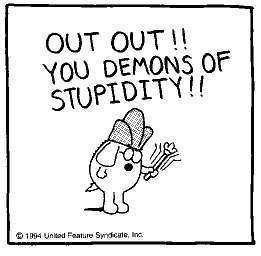
"Well in MY room I have an academic referral chart. All the kids' names are on the chart with the DIBELS skills and S.F.A. goals listed and whenever the kids master a skill, they get a star. If they don't master the skill and make progress, they get a minus, and those kids you know, they don't like hearing their friends say 'ooooohhhhh! You got an academic referral! Ohhhhh!' Those kids know the pressure is on!" At which point I not only THOUGHT the following, I said it: "Oh good! Five and six year olds with ulcers! Sign me up for THAT!" I then remembered the graphic above that I had come across while dressing up my MySpace page, and it seemed to **fit.**
Math skills? Science? Social Studies? Socialization? Fine and gross motor skills? How kids "feel" about school? Nooooooooooooooooooo, NOT the priority. DIBELS DIBELS DIBELS. "Hey, those kids have to be introduced to the types of assessments they face in the upper grades, might as well start them now!" Yes, another quote.
I never thought I'd be one of the "old timers" with only thirteen years of experience under my belt. One of those old-fashioned teachers who talks about "teaching the whole child." An old bitty who has favorite authors and can think up the names of books and poems for kiddie lit. on her own. Someone who actually believes in thinking OUTSIDE the box, and frankly believes that we SHOULD be able to teach our way out of a paper S.F.A. bag. A crazed eccentric who believes in shifting the paradigm, and therefore KNOWING the paradigm. The outdated model that can actually punt when necessary, and think on her own.
No, apparently here in Oz, teachers are much too worried with impressing the Wizard to be bothered with even noticing the curtain at the left-hand corner of the room. And so it's not Glinda's crown and wand I'm wanting. It's Dilbert's dog's.


Sunday, March 04, 2007

Climbing the Walls for Students

hook
Apologies in advance, I'm still recovering from our latest round of Parent Teacher Conferences and all of the germs that have taken an extended tour in my classroom this month. As a result, my brain has had to sort through a Sudafed-haze before coming to any semi-clear landscape where the teacher's voice inside my head can speak without generating a painful echo. Nice acoustics in here when I'm sick though...or perhaps I should be worried?

As usual, the part of me that craves efficiency, simplicity, an Occam's Razor bottom-line when it comes to kindergarten issues, is feeling a bit let-down after conferences. Many parents attended ready to talk and interact, interested in not only how their children were doing academically but socially as well. They made proactive statements, asked proactive questions, and expressed interest in not only the Here-and-Now but on down the line as well. Several other families, recovering from their own bouts of illness attended and made sure to bring their grocery-list of questions to remember to ask (I assume they too were navigating a cold/flu medicine fog) which we readily covered, checking off each topic as we moved from handwriting, coloring, math skills, recess behavior, school crushes (yes, this early), and whether or not PE shoes were getting too tight. Finally, the Award/Accolade/Keeping-Up-With-the-Joneses-by-Pushing-Our-Children-to-Ridiculous-Extremes families attended. They voiced their concerns with accusatory questions, such as: "Why isn't my daughter reading at a second grade level by now like her brother was at her age?" "What do you mean, there is no Gifted and Talented Program for my child in kindergarten?" "Why isn't my son sitting and sounding out words for several hours each day at school, he will learn to read, won't he?" "Isn't it time to move the students away from those learning centers? I mean, they're just PLAYING." You get the idea, and I'll bet you have a very clear mental image of who I'm talking about.

Just to let you know, the accusatory part of the questioning isn't what bothered me. I've taught long enough to know that while I can't please everyone all of the time, I can still do a good job and provide students valuable, fun, and meaningful learning experiences that help build their foundation for not only school, but for life. The part of the Scorekeeper Parents' questions that bothered me was the fact that they clearly reflected the families' true nature of competition instead of care. Acquiring shiny trophies over acquiring a decent self-truth. Hoop-jumping instead of Life-Living. It also reminded me of just how little parents CHOOSE to know about their children, and therefore, about me and the job I do. Oddly, it still surprises me annually when I'm faced with the realization that some of the parents of my students don't feel the need or obligation to think outside of their own boxes when necessary, which happens on a daily basis with children. It must be the optimist in me. I trust that people will think, explore, postulate, and re-evaluate. Perhaps it's a natural carry-over from the fact that I'm PAID to help children do these things. It's a bridge to me until I run smack into the wall that some parents have somehow managed to bring along with them on this kindergarten trek. And each year, I have to have the rope and grappling hook ready to fling over the wall, the fitness and fortitude to haul my butt up to the top, and then the diplomacy skills to entice the parents to scale their side of the wall to join me for a looksie.

What do I try to show the parents who join me at the higher altitude?

That reading isn't sounding out words in boring texts. "Sad Sam was sad" isn't NEARLY as interesting or literacy-rich as "NO DAVID!" (Be honest S.F.A.'ers, do you really LIKE those KinderRoots "books" or does David Shannon speak more to your own inner-reader?). Guess why?

That learning is three-dimensional, multi-sensory, and consuming. It offers new information, it helps develop preference, it gives us a common language and schema so that we may better communicate and interact, and it offers its own rewards and pleasures. Ask any adult trying a new cuisine for the first time about their own apprehension, their awkwardness, their fear, their effort, their discovery, their satisfaction, and their possible JOY at having learned or found something NEW. That's what children experience daily, all the time, and not just with food, but with LIFE. It's not **just** playing. It's learning. It's developing. It's reinforcing. It's expanding. It's negotiating, sharing, and making other discoveries possible and less frightening. Don't take away those Lego's just yet. Yes, the silly puppet voice really does help. Shake your Sillies Out regularly. For some kids, mustard and peanut butter sandwiches are AWESOME tasting.

That test scores aren't the bottom line and they aren't who your children are, no matter what a teacher tells you. No matter what a school district report card tells you. No matter what a nation's government administration tells you. Personal preferences aside, parents, employers, neighbors, are always going to be wanting to rank each other in some form, in some way, for whatever reasons.... be they good ones or not. It's the nature of our beast. But if YOU don't like being merely a number, don't do everything in your power to turn your child into one (or let others do it for you). Remember, figures don't lie, but liars sure can figure. Imagine your life today if it was steered by that one red-ink percentage score on the French test you failed in high school. Not cool.

And finally, parents need to be brave. Choose bravery over living in fear. Your children do it every day in my classroom. Don't fear the tests. Don't fear the Joneses. Don't wake up shaking because your daughter only has a Dora backpack instead of a Louis Vuitton. Get some finger paint out. Bake some cookies. Catch some bugs. Listen to the rain. Sing a song. Have a book swap with your friends and neighbors. Actually TRY eating green eggs and ham. Stop. Listen. Think. Hear. Smell. Taste. Touch. See. Live. It's how you discover what your own Big Picture is. It's how you help your child discover his or her own. Enjoy your discoveries. Don't fear them. If you like trophies, these are the shiniest of them all.

Thankfully, enough parents each year scale that wall, balance at the top for a bit, and then join me on the other side. The optimist in me can't help looking forward to the year that the bridge runs unobstructed from point A to point B, with mutual sharing and learning motoring both ways. Until then, the rope and grappling hook are properly packed and stored.

Happy Almost-Spring. Time to read some Carl Sagan again before the next round of Sudafed. Maybe it will help!

Tuesday, January 16, 2007

Mid-Year Reflection....Planning!

Half the year is over, so it seems appropriate to reflect on what is working in my classroom, and what is not.

My students are as they should be: eager to learn ("What are we gonna learn today, teacher?"), inquisitive ("How come people keep asking me if I lost my tooth? I put it in my pocket until I got home and then Mom put it under the pillow and the Tooth Fairy got it and gave me money. It's not lost. SHE has it!"), expressive ("You know teacher, I'm learning how to not pick my nose no more 'cause Gramma says that's gross!"), tolerant ("Teacher, he's being a pest but I think he won't be so sassy at recess."), helpful ("I can help you write those "k's" 'cause they're hard.") entertaining ("Teacher, Mom is proud of me 'cause I learn-ded my money! I know quarters, nickels, pennies and DIAMONDS!") and kind ("She fell down at recess but I think her mouth hurts so can I take her to the nurse and talk for her?").

Managing the curriclum requirements is going well also. I've been able to align my lesson plans with the state's kindergarten standards and benchmarks, our curriculum materials for the most part are useful, or at the very least, "tweakable," and my students are making progress not only academically, but socially. DIBELS, Round Two is coming up, though I'm not too terribly concerned with how lost my students will look as they try to sound out nonsense words and name letters that they at this point, only use the sounds of for writing. My students recognize more and more sight words each day, enjoy writing and drawing, and have even picked up some science, social studies, art, and music concepts despite the best efforts of NCLB to obliterate those areas of "interest" from public schools. How many kindergartners do you know who will ask "Teacher, when do we get to listen to 'Night on Bald Mountain' again?"

Parents are involved and have continued to volunteer in our room, or drop in for visits and observation. I get email regularly from parents who just want to "touch base," or do some mutual sharing of kindergarten "funnies" that are observed at home or at school. Apparently a few homes get a replay of "me" each afternoon or evening after dinner as children play "school" in their rooms. All of my students' families attend parent teacher conferences. There's a good bond of teamwork going on this year.

My kindergarten-colleague is a joy and brings laughter and levity to those not-so-fun chores of paperwork, meetings, and... more paperwork! We enjoy our own Vulcan-Mind-Meld communication that other colleagues watch from a distance for entertainment, and we readily use our cell phones when necessary for "heads up" calls to help eachother navigate any surprise mine fields that periodically appear. We don't merely have polite professionalism between us, we have a fun friendship! You know what blessings those can be.

Having learned School #3's unique schedules, colleagues' names, district's strengths and shortcomings, and of course, neighborhood quirks during the first semester, the only hold-over issue appears to be PLANNING.
paperwork* I do lesson plans for the After School Program.
* My grade level partner and I plan for our T.A. Time (a prep supplied by a teacher's assistant who takes our students to another classroom and uses materials we've prepared and explained beforehand- yes, you've read that right, we "prep for a prep.") two or three times per week (usually we try to plan for a month's worth of T.A. lessons in advance).
* If it is indoor recess and I have duty, I have to plan activities and lead them for first grade students.
* I plan activities and prepare materials for the paras (aides/paraprofessionals) assigned to help my students with IEP's.
* I prepare materials and provide screening results for Speech, Academic Support, and E.L.L. staff members for when they work with my students.
* I help plan and prepare for professional development activities.
* My kinder-colleague and I planned and hosted this year's Secret Santa activity for the staff.
* I plan activities that our fourth grade buddies help us with two or three times a month.
* All teachers must meet with the district Art teacher because while she prepares the materials for projects and leads the process at the front of the room during each visit, she does not choose the lessons herself, or align them with grade level curriculum requirements. If we have "extra" information we'd like the students to know about a particular artist, or would like to tie in the art project's PRODUCT to whatever concepts we might be learning about at that time, we have to prepare additional lesson time or explanatory notes to glue to the back of each handprint flower or sponge-painted buffalo (hey, Kansas Day is coming up!). Any books or stories to accompany the project? Yep, we gather those too.
* And lately, due to illnesses and death in the family, I've had to prepare plans and materials for subs, which any teacher knows can be more labor intensive than regular teaching.

My kinder-colleague and I have been approached by the school librarian. She's feeling a bit left out because she only sees our students when they come to return their books and check out new ones. Library Science is not taught at our school, nor is "library time" a prep option, like Music, P.E., Computer Lab or T.A. times are at many other schools. Our "liberry-lady" would like to get together and spend some of our planning times...planning. Activities and lessons that she can co-teach with us in the library. And as dear a lady as she is, we have been unable, and yes, unwilling to give up more time to go and plan for yet one more person in one more corner of our building.

I can entertain the thought that perhaps I'm merely seeing the glass as half empty instead of half full. I am very appreciative that this district supports collaborative efforts in doing what's best for our students. I am even more pleased that so many colleagues at my school WANT to spend time with us. It means a lot that so many people enjoy my Super Stars the way I do, that so many look forward to their time in our classroom. I am pleased that my students have diverse learning opportunities available to them. But let me be blunt: there are too many spoons stirring the "pot" this year. Too much of a "good thing" isn't a good thing for five and six year olds. I'm used to providing a nice balance between a safe, predictable routine and exciting (yet still safely predictable) surprises or "extras" for my students. But the balance has been tipped grossly to one side, the side where my own time with my students is gobbled away just so we can say we are all collaborating and giving kids as many different learning opportunities as possible. And frankly, in most cases, it's not true collaboration. It's ME getting materials and lessons prepared for others to attempt to teach.

My students are still learning how to "be" at school. They're not seasoned fourth or fifth graders who know the drill and how to maneuver quickly through all of the resources, materials, personalities and expectations they encounter. My kids have just now noticed there are rectangular ceiling tiles in my room. They've noticed. They are commenting on them. They are distracted by them. Ceiling tiles. Because ceiling tiles are interesting. More interesting than the concepts of "putting together" and "taking apart" are at this point in time. Going to the library to have the librarian "help me" teach addition and subtraction this week is... I'm sorry... ridiculous. It won't happen. Because while I'll be able to get my kids back on track (and even use those ceiling tiles for math soon enough!), taking them to the library would just send them off in a completely different direction, for DAYS! Books! Stuffed animals! Computers! Steps! Round tables! Wagons! New cabinets! Maps! More stuffed animals! Shelves that present great potential for climbing! The hunt for a new bathroom! Card catalog drawers! Whoo hoo!

And yet I've been asked to plan... help plan... so that the librarian can feel involved. So that I can say I'm "doing my part" to provide another valuable learning experience for my students. As if I weren't doing my part already. And yes, attempts at tossing feelings of guilt upon my shoulders have been made.

Valuable Kindergarten/Life lesson #35: "Know when to say 'no,' and know that it's okay to say 'no' sometimes."

Tuesday, September 26, 2006

Helpful Kindergarten Web Sites

kinder
Here are some helpful kindergarten web sites- good links with lots of info for those of us tending the "kidney-garden:"

Kindergarten Teacher

"The purpose of Kindergarten Teacher is to provide a comprehensive and organized collection of substantial educational content available via the Internet and of value to those who teach or intend to teach kindergarten."


The National Kindergarten Alliance


The National Association for the Education of Young Children


The Top 10 Signs of a Good Kindergarten Classroom


Kindergarten ChatBoard at Teachers.net


Can you recommend any others?