Showing posts with label DAP. Show all posts

Saturday, March 14, 2020

Extended Home Time: Digital Resources and Learning Tool Tips for Families

We received news today that our teenager has another week of Spring Break, while today is my first day off. How am I spending my Saturday? Collecting video content to share with my students' families just in case our vacation is extended, too.

Thanks to our efforts to reduce the effects of COVID-19, my students may have the opportunity to reconnect with family, enjoy more unstructured and imaginative playtime, and explore their interests more fully.  But being with children all day long is not an easy job. Our established schedules are essential for helping kids to self-regulate, anticipate and plan for activities, and feel safe as they adjust to unanticipated changes, so the sooner a dependable routine is put into place at home, the better.  And, admittedly, parents and caregivers are going to need some ten or fifteen-minute blocks of "free" time as they find ways to help their young learners fill their days away from the routine of school.  

I've used Symbaloo to collect and sort digital content for my students for several years now, and have appreciated all of the webmixes that have been shared by others that have made it possible for me to NOT have to recreate the wheel while discovering wonderful resources such as Art Hub for Kids, Cosmic Kids Yoga, and Sag-Aftra Foundation's Storyline Online (they have a free app!) at the same time.

If you're wanting to offer families and students some additional content to help them get through their days off from school, feel free to explore Symbaloo by signing up for a free basic account, and use the search function to find webmixes like mine:
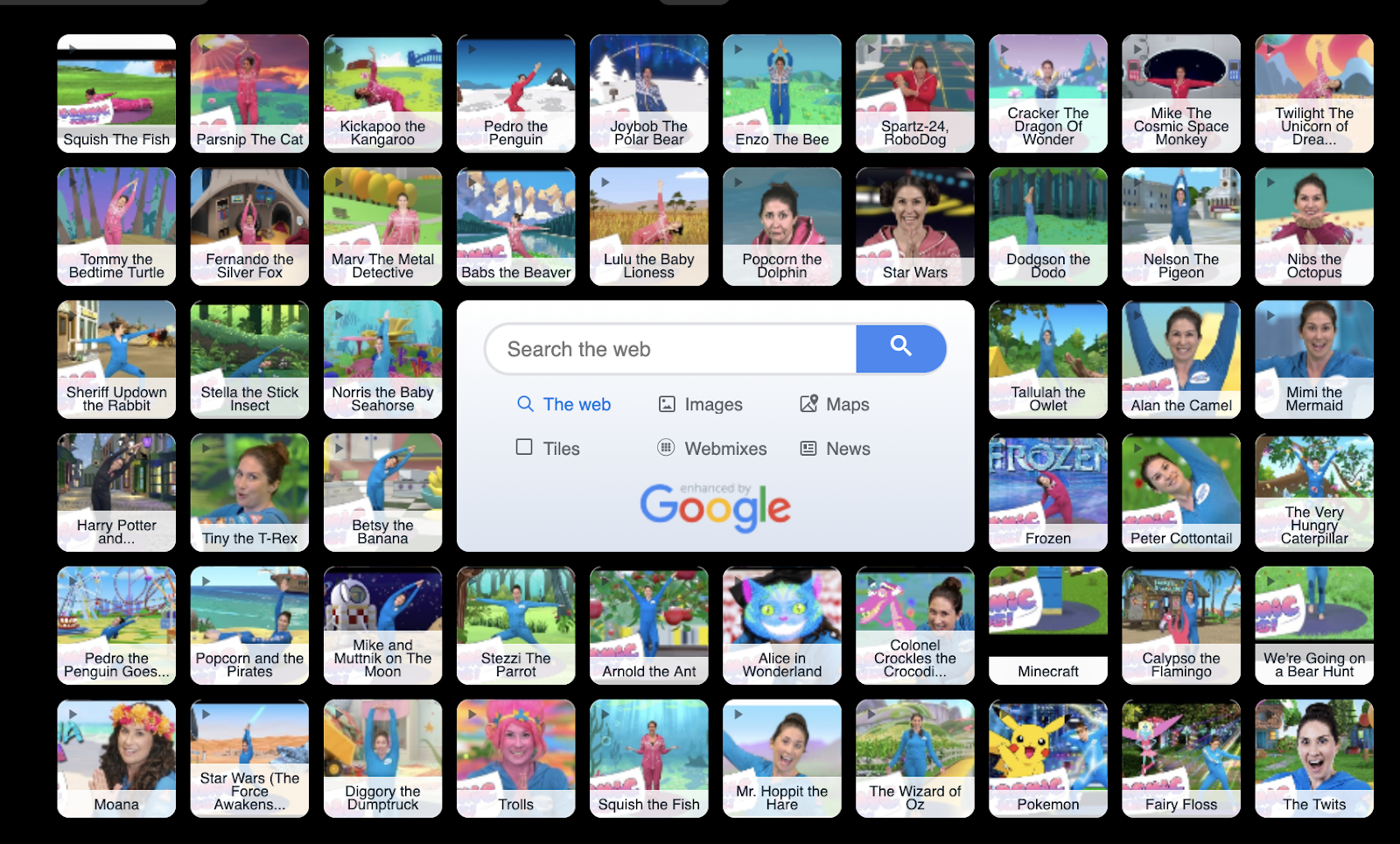


Story Time webmix here.


... and How to Draw webmix found here.

What kinds of activities might families want to plan for as they work with their children at home? Creating a schedule, for one, assigning blocks of time for meal preparation, chores, playtime with siblings, storytime, exercise and/or fresh air opportunities, quiet time (away from siblings), writing and drawing, exploring math concepts (not everything has to be a math worksheet, by the way), creative expression/art, music and movement, and clean up. Plan it, schedule it, follow it every day. 

Families who have heavily relied upon schools to provide their children with opportunities to use markers, scissors, paint, and other tools, may now find themselves in need of quick tutorials on how to set up a writing or art station at home.  Before exploring inspiration boards on Pinterest, these parents should know that they will want to supervise their children when they allow them to use scissors and tools with ink at home: no leaving cutting tools, markers, pens or paint down and within easy reach until a routine regarding their use is well established. After each day's clean up, these tools should be collected and safely stored by the adult, unless they'd like to discover that their walls, furniture, clothes, and even pets have undergone a colorful and choppy transformation. 

What do children love to use? 

Colored pencils
Markers
Stamps
Paint, paintbrushes (but Q-tips and other objects used for stamps are fun too!)
Pens
Crayons
Paper: construction; writing; painting; old magazines and newspapers; even junk mail!
Play Doh (here's a link to a make-at-home version from This Tiny Blue House)
Rulers, yardsticks, tracing stencils
Cookie cutters (for dough and for tracing)

Parents can round these items up, sort them and store them in tubs, containers, or clear baggies and put them near the area where they will be used most often, making sure that their children sort them into their proper containers at the end of each day.  Then the adults can disinfect the items and let them sit overnight up and out of reach. Toys, books and puzzles can also benefit from a good sorting and cleaning after extended and repeated use, which children can easily do with guidance and supervision.  When these items are ready for some disinfectant, parents can utilize a digital resource such as yoga, a directed drawing activity, or storytime video in webmixes like those above to engage children, while they clean doorknob germs and wipe down surfaces to help maintain a healthy living space.

Or use the bathroom, you know, like teachers do. 

***** 

Edited to add on April 13, 2020:

Hello Kelsey, I'm glad you were able to find something useful during your visit to my blog.  I've taught kindergarten for twenty-plus years now, and have found that the two constants in education (when we consider things such as instructional styles, tips and tricks, technology adoption and effective use, or even our current COVID19 crisis, etc.)  are change and inequality.  The needs and strengths of students, teachers and communities differ in the here and now, AND they evolve over time.  For educators like me who have taught in culturally diverse parts of our country, that change is marked not only with each successive school year but during each relocation to a new neighborhood, town or state.  In addition to developing well-rounded, inclusive pedagogy, I'd have to say that two of the most necessary skills that effective educators must develop are 1) the ability to make a silk purse out of a sow's ear and 2) the ability to quickly filter through of all of the content that is tossed into their faces.  Be able to make the most out of what you have, and learn to sort through the sea of salesmanship so that you are putting the best resources available into the hands of your students.  Create, and appreciate NOT having to recreate the wheel when you encounter a quality tool.  

When I first began teaching, I knew I could ask the reading resource teachers, speech and language interventionists, bi-lingual liaisons, cafeteria staff, OT/PT staff, the school nurse, neighborhood businesses, and my grade-level and building colleagues for help.  Some of my colleagues taught in isolation, regularly closing their doors to everyone but students.  Moving from state to state, it became clear that the personalities and cultures of the schools in which I taught each shared some stereotypes, while still remaining unique from one another. And certainly, the financial disparities that existed between schools and districts within not only regions or individual states in this country, but within each of the towns that I moved to and taught in, have remained. Now I PLC, which in a nutshell, is meant to prevent me and my immediate grade level team from having to pick up a phone, or walk down the hallways, possibly encountering more closed than open doors, as we search for ways to improve our instruction: everyone is "available" to us as we interpret data to assess student need in order to fine-tune and target our instruction.  But I'll tell you something: while "loner" teachers might be sitting in the same room as the rest of their team, that doesn't mean they're contributing any more to the common good than they would have been if they had been allowed to remain behind their closed classroom doors.  And if only one specialist is shared amongst more than one school, immediate help or input isn't available when it's most needed or most convenient.  

I truly believe that educators (and consequently their students) benefit when they purposely grow their PLN, seeking out inspiration and advice from others not only in their building, district, or even state, but from across the nation, multiple professions, and even the world. Twenty-some years ago, I assumed I'd experience a gradual, measured evolution of my pedagogy, using the building blocks of inservices, book studies,  classroom experiences, an over-reliance upon local resources and possibly occasional holiday travel to widen my view.  I never would have imagined that I would be able to learn from and bounce ideas off of teachers and other experts around the world in real-time.  I never imagined hosting a parent-teacher conference with a mother sitting at my reading table and a father sitting in an Army tent overseas.  I am thrilled that I could search for and find content such as the yoga, art and storytime videos that I've compiled into the webmixes written about in this blogpost, and that a platform such as Symbaloo exists to support access to them.  

While I remain a caring, invested, purposeful teacher and learner, the resources that are now available to me (which I credit mostly to advances in technology) make it possible for the walls of my classroom to expand as I cherry-pick from a global range of fellow sharers.  At this point (but who knows what tomorrow's news cycle may bring) there is no reason for me to believe that my pedagogy won't continue to evolve at a rate that matches the needs of today's learners.


Friday, November 20, 2015

Children Can Emulate Native Americans Without Adults Screaming "RACISM." Here's Why:

After reading through a debate regarding a parent's complaint about pre-k students making construction paper feather headbands in November, I came across this post at Education World, "Are You Teaching the 'Real' Story of the 'First Thanksgiving?'"  The article and debate made me realize how lucky I am to have been brought up the way I was as the child of  both native and non-native parents.
Born in Kentucky and raised for the first ten years of my life in Texas, I was fortunate to have the opportunity to be immersed in Inupiat culture, and live for over two decades in a state where Native peoples' values, history, songs, beliefs, mythology, subsistence lifestyle, and art aren't merely on display for one month out of the year: Alaska.  I learned about the good, the bad, the historical cruelties suffered by, and remarkable achievements of Indigenous Peoples. I have been a witness to the prejudices that remain and feel pride in the accomplishments and contributions of my Native family and friends today. Endurance, strength, resilience, community, love for family, pride, skill and artistry are all traits worthy of being shared, respected, and celebrated, no matter a person's ethnic or cultural background. 
To develop empathy, children must be encouraged to walk a mile in another's shoes, to imagine how they might feel when meeting strangers for the first time, when deciding who and HOW to trust. Young children try on the clothing and garb of others every day, from their mom's high heels to their dad's Army cap, to sister's riding boots and brother's varsity jacket, developing their personal identity by trying on the markers of others.  They also emulate family members, friends, sports heroes, celebrated musicians, actors, historical figures, community helpers and those blessed with a special talent or gift.
Can children create feathered headbands without the kitsch or racist connotations that instantly pop into their parents' minds upon viewing? Absolutely, but it's up to the teacher to share culturally relevant and accurate information about the earning of feathers (or wearing of a blanket, mask, or story belt) with students AND families.  It's also a family's responsibility to try to understand the intentions behind a lesson or activity before rushing to judgment and labeling a teacher as racist or insensitive.  Do I find it offensive if children emulate respected chiefs, warriors, healers, or shamans, just as they do ballerinas, astronauts, painters, singers, veterinarians, or teachers?  No.  Just as teachers, family and society expose children to other professions and roles worthy of respect through literature, history lessons, field trips, guest speakers, arts and crafts, so too can we teach children about Native Americans and Indigenous Peoples.  Native AND non-Native teachers need quality non-fiction materials and resources, or know how and where to find them. It's also up to teachers and parents to be aware of what's not only culturally sensitive, but developmentally appropriate for young children. 
Three, four, five and six year olds do not need to be exposed to and master the vocabulary of genocide because of the gut reaction of the adults around them. Rather, children should be gently guided as they broaden the scope of their universe from their immediate selves and family to their neighborhood, community, state, nation, and world.

Sunday, November 08, 2015

Is it Possible to Provide Academic Rigor ~Without~ Dramatic Play?

Being extremely busy at work while also spending the past two months battling allergies/sinus issues/bronchitis/the common cold/pneumonia has kept me away from blogging for quite some time.  My Super Stars will tell you that I'm on the mend though, because last Wednesday and Thursday, I actually sang a song, all the way through, and didn't forget any words OR COUGH mid-verse.

Look!  It's a light at the end of the Respiratory Tunnel!

Being unable to speak (or sing) did make for increased opportunities to participate in online chats via Twitter and Facebook groups during the lead up to Halloween, and the predictable debate between fellow teachers regarding whether or not dressing up at school was educationally relevant.  A lament across multiple chat threads occurred when fellow early childhood teachers expressed frustration that they weren't allowed to have dramatic play or "pretend" centers in their classrooms. Many veteran teachers shared stories of how they had been asked/told to remove their dress up and puppet centers to make room for more "rigorous" activities, such as worksheets or increased time in front of a computer.  These demands were all made by tech-integration advocates, administrators and school boards, none of whom specialize in child development (it's a real thing).

Considering that children, young adults, and grown ups regularly:

1) go trick-or-treating wearing masks and costumes, using props that they don't usually need in their day to day lives
2) experiment with new hairstyles, clothing, and cosmetics
3) wear the jerseys and sports colors of their favorite athletes without necessarily being athletes themselves
4) don gowns and tuxedos or suits for dances, weddings, anniversaries, proms, birthdays, and religious events
5) participate in cosplay events, portraying their favorite superheroes, book, television, and movie characters
6) wear their "Sunday best" for church
7) participate in clothing themed days for Red Ribbon Week (Wacky Tacky or Pajama Day anyone?)
8) dress up OTHER items, such as their pets, or turn soda bottles or pumpkins into book characters for school projects
9) and perform in dramatic, romantic, or comedic theater

...advocates of developmentally appropriate practice are right to be bothered by the double standard regarding imaginary play.

As illustrated in the list above, it's obvious that adults support dress up and pretend play when it comes to emulation, entertainment AND education, but for some reason, when they walk into a kindergarten classroom and find a child-sized kitchen, box of dress up clothes, or creative construction zone where students fashion artwork and props for their own dramatic play, many voice concerns and criticisms regarding rigor, academic readiness, and "real learning."  Parents are worried their children won't really learn what it means to be at school if they're playing with dolls, filling purses, or pretending to cook a Thanksgiving feast with plastic food.  Teachers worry that the time children spend trying on the roles of others and practicing social skills will reduce the amount of time available to cover academic concepts required for kindergarten mastery.  Administrators can't figure out where dramatic play falls on the evaluation rubric they must use as they determine the efficacy or needs of their teachers, because "developmentally appropriate practice" isn't included on many observation tools or checklists.


My kindergartners like to pretend to be superheroes, villains, weather elements, soldiers, or fantastical creatures when they're outside playing during recess.  They also run, kick, bounce, throw, and catch balls, swing, climb, slide, and work their way across monkey bars.  They roll in the grass, race with their friends to the fence and back, and try to build nests from fallen leaves and twigs.  In our classroom they pretend to be mothers, fathers, older siblings, chefs, veterinarians, office workers, authors, illustrators, and even teachers, their dramatic play role models being more closely associated with real life.  These girls were pretending to be mommies out shopping.  They packed their purses, prepared their babies, and took along their "cell phones" so that they could call one another in the mall to find out where to meet for lunch when their shopping was done.  During dramatic play they regularly "ran into" one another at the mall, discussed purchases they had made, determined which stores they still needed to go to, helped one another with her "baby," and negotiated which restaurant to meet at and what type of food to eat for lunch. One of the girls even created an ATM card out of a post it note to use when paying for her meal, adding her name to the note and the numbers 123456789.

During pretend play, my students' language use and development far surpasses mere vocabulary exposure.  Increased use of adjectives, tenses, and the corrections by peers of misused words can all be heard as classmates try on the personalities of individuals or animals other than themselves.  Empathy, sympathy, humor, and the growing awareness of multiple perspectives helps to widen the scope of each child's world, a development also facilitated by pretend play during our center time.  Opportunities to expand upon concepts introduced somewhere ~other~ than a desk and chair help my students to express their creativity.  Why merely cut and paste pictures of animals on a worksheet that a veterinarian might help, when I can invite students to bring stuffed animals from home to create an animal hospital, complete with stethoscopes, play medical kits, bandaids, scrubs, surgical masks, and cardboard boxes?  Adding paper and pencils to the dramatic play corner enables "animal doctors" to write down prescriptions and medical directions for pet owners, and signs for designated treatment areas too.  Is there another activity where reading, writing, math, sequencing, cause and effect, fine motor, communication, negotiation, turn taking, language and social skills development, problem solving, transitioning, sorting, and cleaning up after oneself are all completely integrated?  And guess which activity is always marked by 100% student engagement and time on task?  That's right: dramatic play.

Casual observers and critics demand to know how we can provide academic rigor through pretend play, to which I must reply:

How can we provide academic rigor and opportunities for growth and development without it?

Sunday, May 17, 2015

I've Said it Before, and I'll Say it Again

Reading David Kohn's "Let the Kids Learn Through Play" this morning, my child advocate's voice asserted itself loudly in my head, greatly surprising me since I'm facing the last week of kindergarten, a time when many teachers are near collapse from exhaustion and the wide range of emotions washing over them.  Instead of grumbling incoherently, the voice roared "I've said it before and I'll say it again:"

What I really wish new-to-service teachers, ivory-tower administrators and bubble-boy/girl politicians understood is this: play does not equal "unproductive and non-beneficial fluff time."  Rolling over, crawling, standing upright, balancing, walking, running, climbing, and babbling are ALL challenging to the child beginning to develop his or her skills.  So too are sharing, negotiating, coming to understand cause and effect, developing patience, and learning to use new tools safely and efficiently, such as pencils, scissors, squeeze glue, buttons on a keyboard, or the fragile skin of technology and books.  Don't forget to add broadening language and building stamina to the mix as well, especially because a child's typical work day is full of new tasks, deadlines, social mores, and transitions requiring copious amounts of sustained attention and interaction.  Yes, the "school day" IS a work day schedule that young children are introduced to when they start kindergarten, and it's not an easy or immediate adjustment to make.  I've always found it ironic that many administrators will tell you that kindergartners "don't need naps" by the end of the school year, though we all know plenty of adults who require rest and down time throughout the day.

Because advocates for developmentally appropriate practice are regarded as old softies, our pedagogy is assumed to be lacking in "rigor," "challenge," and even "standards," likely because we insist on giving our students plastic knives at the play doh center instead of surgical grade scalpels.  Well-intentioned (and usually inexperienced) colleagues and administrators bound by asinine funding equations run roughshod over our suggestions, protests, and advice when we dare to express what is obvious to us: young children aren't committing a crime, lacking gumption, failing to perform, or offensive because they're not behaving like short third and fourth graders during their preschool and kindergarten years.  Even worse: teachers who don't appreciate or even like all of the incredible things that four, five and six year olds are, take positions where they inflict their distaste, judgement, and severe lack of knowledge regarding child development upon our youngest learners. These adults are easy to recognize: they're the ones complaining in the lounge or staff meetings about how "these little kids just don't get it" or "they just can't DO anything," while those much better suited to the grade and students are expressing how the academic expectations or assessments aren't appropriate matches for the children we teach.  Guess which group of teachers is regularly criticized for their point of view?  

The development that naturally occurs through play, exploration, partnership, and emotional bonding is not an affliction or unnecessary detour from all things curricular: it's an essential prerequisite for further growth.  Children must, with very few exceptions, roll over before they crawl, crawl before they walk, and become acquainted with and develop many more skills that are necessary in order to build a firm foundation upon which their ABC's, 123's, empathy, and life's passions will stand and grow.  These stages of skill acquisition occur on a continuum: you don't hopscotch over a few squares to get to the end faster, or interpret the wobbly or full face-plant landing as proof that a child needs ankle braces, ski poles, smaller squares, larger squares, or a stunt double in order to be successful within the  grading period allotted.  Time, practice, and encouragement, not developmentally inappropriate demands and deadlines, are the initial supports most children need as they continue their journey as brave, capable human beings through play and partnership.